 Làng nghề
 Di tích văn hóa & lịch sử






♦ M.A. Dang Thi Anh Tuyet
thuongFor Hanoians, pho is a ritual. It is the longing of those who live far away, the pride of those who stay, and the warmest greeting offered to anyone who sets foot in this thousand-year-old capital of culture. Hanoi pho leaves an imprint in the memory of every visitor, from humble street vendors to today’s bowls of pho that fully live up to their reputation.
Pho emerged around the early twentieth century. Although there has long been debate over whether pho originated in Nam Dinh or Hanoi, whether it was influenced by French cuisine or by Chinese beef noodle soup, one undeniable truth remains: Hanoi is the place that elevated pho into an art form. In the 1940s, writer Thach Lam, a renowned connoisseur of Hanoi cuisine, once wrote in his essays: “Pho is a special gift of Hanoi. It is not that only Hanoi has pho, but only in Hanoi does pho taste truly good.” The image of mobile pho vendors, with one side carrying a pot of broth constantly boiling and steaming, the other holding meat, noodles, and seasonings, moving through the Old Quarter with their distinctive calls, has been deeply etched into the memories of generations. Through historical upheavals, from street-side pho stalls and “driverless pho” during the subsidy period to today’s air-conditioned pho shops, the core flavor of Hanoi pho has been preserved like a treasure.

What sets Hanoi pho apart from pho in other regions is its refinement and subtlety. This is most evident in the broth, the supreme test of the cook’s skill. Broth is the soul of pho and the ultimate measure of craftsmanship. Authentic Hanoi pho broth must be simmered from beef bones, including marrow and oxtail, for many hours, often ten to twelve, to extract a natural sweetness.
Yet sweetness alone is not enough. The broth must be clear and fragrant, with aromas derived from grilled ginger, grilled shallots, star anise, cinnamon, and black cardamom, combined in a closely guarded ratio. Hanoians are particularly averse to cloudy broth or sweetness derived excessively from sugar or monosodium glutamate. The sweetness must be lingering, deep, and mellow, drawn naturally from the bones.
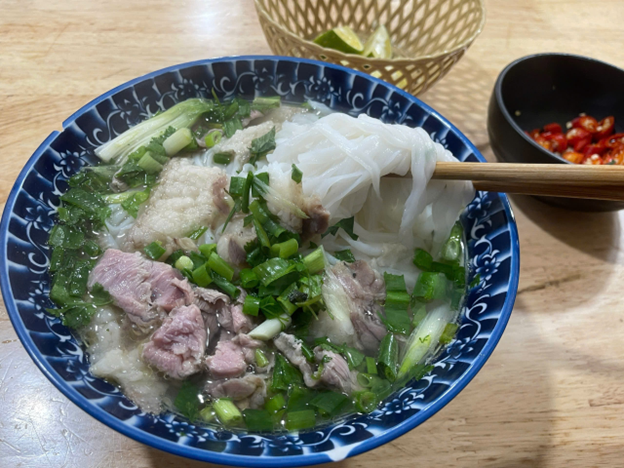
Hanoi pho noodles must be fresh. The noodles are thin, flat, and ivory white. When briefly blanched, they should be just soft enough to blend with the broth while retaining a slight chew, never becoming mushy. In the mouth, the noodles seem to dissolve gently, sliding down the throat with ease. Although beef pho is the original version, Hanoi chicken pho holds an equally respected position.
Beef pho offers a full range of cuts, from rare beef, well-done beef, brisket, flank, to tendon. The beef is sliced paper-thin, lightly tenderized, and quickly dipped into boiling broth to retain its rosy hue and tenderness in the case of rare beef, or its fragrant ginger aroma when fully cooked. Chicken pho typically uses free-range chicken, with crisp skin and firm yet tender meat. Particularly prized is the golden chicken skin, sliced into bite-sized pieces and garnished with finely shredded kaffir lime leaves, releasing an enticing aroma.
Hanoians eat pho with great care. It is not merely about sustenance; it is about enjoyment. On the table of a proper Hanoi pho shop, one will always find garlic vinegar, with pristine white pickled garlic cloves that add a gentle sourness, balancing the richness of the broth. Traditionally, Hanoians prefer vinegar over lime. Chili sauce must be handmade, vividly red, pungent and spicy, not overly sweet industrial sauce. A light sprinkle of black pepper enhances the aroma, and crispy golden fried dough sticks are indispensable. Dipping the dough stick into the broth to soak up its rich sweetness is an experience in itself. Unlike southern pho, which is served with a large plate of fresh herbs such as saw-leaf herb, Thai basil, and bean sprouts, traditional Hanoi pho focuses mainly on scallions, both the white stalks split lengthwise and the green parts finely chopped, along with thinly sliced onion and coriander. This restraint allows diners to fully appreciate the pure, original flavor of the broth.
A visit to Hanoi is considered incomplete without tasting pho at its iconic addresses. Among the most famous is Pho Bat Dan, known for its culture of queuing and self-service, where customers pay first and carry their own bowls. Its broth is crystal clear, richly flavored in the traditional style, with generously sliced fresh beef and an interior that retains the old-world charm of Hanoi. Other celebrated names include Pho Thin Lo Duc and Pho Ly Quoc Su.
Today, pho is no longer confined to Hanoi’s narrow alleys. It has traveled with Vietnamese communities across the globe, from Paris and London to New York and Tokyo. The sign “PHO” has become a culinary ambassador of Vietnam worldwide.
In 2007, the word “pho” was officially included in the prestigious Oxford Dictionary, affirming its global standing. More recently, the arrival of the Michelin Guide in Hanoi has once again honored family-run pho shops, placing them prominently on the world culinary map. Despite countless variations and appearances in luxury five-star restaurants, for true connoisseurs, the best bowl of pho remains one eaten while sitting on a low plastic stool on a chilly Hanoi winter morning, listening to the clink of bowls and chopsticks, and breathing in the warm aroma of star anise and cinnamon.

Hanoi pho is rustic yet refined, humble yet elegant. It embodies the philosophy of yin and yang and the five elements through its seasoning, the diligence of the cook, and the appreciation of the diner. Come and experience it. Do not just eat, but feel it. Let the rising steam of a hot bowl of pho melt away fatigue, and let its gentle sweetness tell you the story of a thousand-year-old capital.
------------------------------------------------------------
References
1. Vu Bang (1959). Mieng Ngon Ha Noi. Writers Association Publishing House.
2. Quynh Anh (2024). Pho Ha Noi: The Journey to Becoming a Renowned Culinary Gift. https://kinhtedothi.vn/pho-ha-noi-hanh-trinh-tro-thanh-thuc-qua-nuc-tieng.
3. Phuong Bui (2024). Pho Ha Noi: The Journey Toward Cultural Heritage. https://laodongthudo.vn/pho-ha-noi-hanh-trinh-thanh-di-san-van-hoa-175306.html.
4. Vietnam Plus (2023). Hanoi Culinary Culture Festival: Promoting the Capital’s Signature Dishes. https://www.vietnamplus.vn/le-hoi-van-hoa-am-thuc-ha-noi-quang-ba-cac-mon-an-tieu-bieu-cua-thu-do-post907678.vnp
5. Nguyen Thi Phuong Cham (2019). Sidewalk Culture in Contemporary Hanoi. Vietnam Journal of Social Sciences.