 Làng nghề
 Di tích văn hóa & lịch sử




♦ M.A. Dang Thi Anh Tuyet
thuongFor Hanoians, Pho is a ritual, a poignant nostalgia for those far from home, a source of pride for those who remain, and the warmest welcome to anyone setting foot in this land of a thousand-year-old civilization. Hanoi Pho has etched itself into the collective memory of every traveler, from the historical itinerant shoulder-pole stalls to the "renowned" establishments of the modern era.
thuongPho emerged around the turn of the 20th century. Despite lingering debates regarding its origins—whether it sprouted from Nam Dinh or Hanoi, or drew influence from the French pot-au-feu or Chinese ngưu nhục phấn (beef rice noodles)—an undeniable truth remains: Hanoi is the crucible that elevated Pho to an art form. In the 1940s, the celebrated gastronome and writer Thach Lam noted in his essays: "Pho is a special gift of Hanoi; not that only Hanoi has it, but it is only in Hanoi that it is truly delicious." The imagery of the phở gánh (itinerant stalls)—one side a simmering cauldron perpetually cloaked in steam, the other a tray of meats, rice noodles, and condiments—navigating the ancient quarters with a distinctive melodic cry, has been imprinted on the minds of generations. Through the vicissitudes of history—from the traditional street poles to the "unmanned" (meatless) Pho of the subsidy era, and today’s air-conditioned eateries—the core essence of Hanoi Pho has been preserved as a cultural treasure.

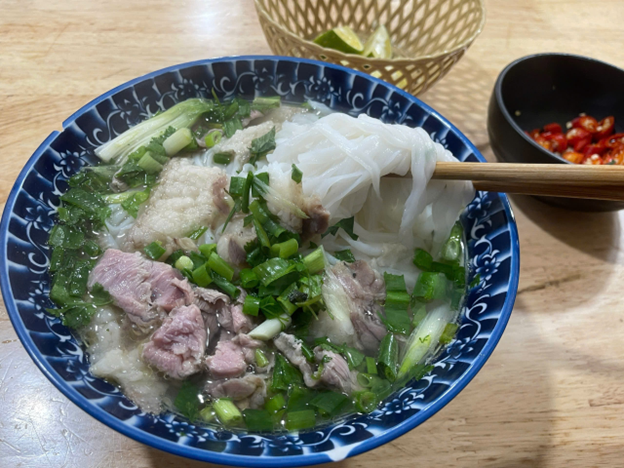
thuongWhat distinguishes Hanoi Pho from its regional counterparts? It is the quintessence of sophistication and ethereal purity. This is manifested in the broth—the chef's supreme craft. The broth (nước lèo) is the soul, the definitive measure of a culinary artisan's skill. Authentic Hanoi Pho broth must be simmered from beef marrow and tail bones for 10 to 12 hours to extract a profound, natural sweetness.
thuongHowever, sweetness alone is insufficient; the broth must be limpid and aromatic. This fragrance is derived from charred ginger, grilled shallots, star anise, cinnamon, and black cardamom, blended in secret, ancestral ratios. Hanoians are most averse to a cloudy broth or a cloying sweetness from excessive sugar or MSG; the sweetness must be a “ngọt hậu”—a deep, soulful aftertaste lingering from the bone marrow.
thuongHanoi rice noodles must be fresh. The strands are thin, flat, and ivory-white; when blanched, they must achieve a delicate suppleness to harmonize with the broth while retaining a gentle resilience without becoming mushy. Upon tasting, the noodles seem to dissolve, gliding smoothly down the throat. While Beef Pho (Phở Bò) remains the "original" masterpiece, Chicken Pho (Phở Gà) holds an equally prestigious standing.
thuongBeef Pho offers a spectrum of cuts: rare, well-done, flank, brisket, or tendon. The beef is sliced paper-thin, tenderized, and quickly poached to maintain a rosy hue and succulent sweetness (for rare beef) or a fragrant ginger aroma (for well-done cuts).
thuongChicken Pho typically utilizes free-range chicken with golden, crispy skin and firm yet tender meat. Of particular note is the glistening yellow skin, sliced into bite-sized pieces and garnished with aromatic, finely julienned lime leaves.
thuongHanoians eat Pho "meticulously". It is not merely the intake of energy; it is an act of appreciation. On a proper Hanoi dining table, one always finds garlic vinegar—translucent white cloves providing a crisp acidity to balance the richness of the broth (historically, Hanoians preferred vinegar over lime). The chili sauce must be artisanal—pungent, vibrant red, and devoid of industrial sweetness—complemented by a dusting of Northern black pepper to awaken the senses, alongside golden, crispy crullers. Dipping the crullers into the broth until they are saturated with savory richness is a quintessential experience. Unlike the Southern style, which features a large platter of fresh herbs and bean sprouts, traditional Hanoi Pho focuses on minimalism: julienned white scallion heads, chopped green scallion, and fresh cilantro. This restraint allows the diner to fully perceive the primordial flavors of the broth.
thuongA journey to Hanoi is incomplete without visiting its hallmark establishments. These names have become legendary brands: Phở Bát Đàn, famous for its "queuing culture" and self-service (payment and carrying one's own bowl). The broth here is crystal clear, traditionally rich, with generously sliced fresh beef, all within a space that preserves the antiquity of Old Hanoi. Additionally, Hanoi is renowned for Phở Thìn Lò Đúc, Phở Lý Quốc Sư, and more.
thuongToday, Pho is no longer confined to the narrow alleys of Hanoi. It has followed the Vietnamese diaspora across five continents, from Paris and London to New York and Tokyo. The "PHO" sign has become a culinary ambassador of Vietnam worldwide.
thuongIn 2007, "Pho" was officially inducted into the prestigious Oxford English Dictionary, cementing its global status. Most recently, the arrival of the Michelin Guide in Hanoi has further honored traditional lineages, placing them solemnly on the world’s gastronomic map. Despite modern variations or luxury five-star renditions, for the true connoisseur, the finest Pho is still enjoyed on a low plastic stool on a chilly Hanoi winter morning, amidst the clatter of porcelain and the fragrant steam of cinnamon and anise.

thuongHanoi Pho – rustic yet sophisticated, humble yet noble. It embodies the philosophy of the Five Elements (Yin-Yang and Wu Xing) in its seasoning, the diligence of the maker, and the reverence of the diner. Come and experience—do not just eat; feel. Let the rising steam dispel your weariness and let that sweet flavor tell you the story of a land of a thousand years of civilization.
------------------------------------------------
References
1. Vu Bang (1959). Hanoi Delicacies. Writers Association Publishing House.
2. Quynh Anh (2024). Hanoi Pho: The Journey to Becoming a Renowned Gift. https://kinhtedothi.vn/pho-ha-noi-hanh-trinh-tro-thanh-thuc-qua-nuc-tieng
3. Phuong Bui (2024). Hanoi Pho: The Journey to Becoming a Cultural Heritage. https://laodongthudo.vn/pho-ha-noi-hanh-trinh-thanh-di-san-van-hoa-175306.html
4. VietnamPlus (2023). Hanoi Culinary Culture Festival: Promoting the Capital's Signature Dishes. https://www.vietnamplus.vn/le-hoi-van-hoa-am-thuc-ha-noi-quang-ba-cac-mon-an-tieu-bieu-cua-thu-do-post907678.vnp
5. Nguyen Thi Phương Cham (2019). Sidewalk Culture in Contemporary Hanoi. Vietnam Journal of Social Sciences.