 Làng nghề
 Di tích văn hóa & lịch sử






♦ Dr. Le Thi Thu Huong
The First Traces of Human Presence in the Land of Hanoi
thuongHanoi is situated within the Northern Delta, yet its topography is not entirely flat. The landscape of Hanoi is diverse, featuring mountain ranges such as Sóc Sơn and Ba Vì, alongside a dense network of rivers, swamps, and lakes. This diversity profoundly influenced the distribution and lifestyle of prehistoric inhabitants in the Hanoi region. The hilly traces in the Sóc Sơn and Đông Anh areas served as "bridges" connecting the midlands and the Northern Delta. Primitive inhabitants from the mountains and midlands gradually migrated down to the ancient land of Hanoi, reclaiming and expanding their residential areas. They settled on elevated ridges of land, forming small villages along the ancient rivers of Hanoi. The earliest evidence of prehistoric human life in Hanoi consists of Paleolithic tools. These are crudely flaked pebble tools discovered in the Cổ Loa mounds, dating back approximately 20,000 years. This collection of pebble tools in Cổ Loa represents the earliest prehistoric cultural traces on the land of Hanoi.


thuongAt the beginning of the Bronze Age, about 4,000 years ago, humans continuously occupied and reclaimed the high lands along the rivers surrounding Hanoi, leaving behind numerous traces. During the Phùng Nguyên culture period, Phùng Nguyên cultural sites were discovered in Hanoi at locations such as Văn Điển (Thanh Trì), Ngõa Long (Tây Tựu), Đồng Vông (Đông Anh), Núi Xây and Yên Tàng (Trung Giã), and the Xã Tắc Altar site (Kim Liên). Among these, the Đồng Vông and Văn Điển sites yielded rich and unique artifacts, primarily stone tools and ceramic fragments
thuongBy the Neolithic Age, the most significant artifact discovered at the Kiều Thị site (Thường Tín) was the shouldered stone adze. This is a representative production tool of the Late Neolithic period, belonging to the Phùng Nguyên culture, dating back 5,000 to 3,500 years. Notably, at the Văn Điển site (Thanh Trì), a stone figurine of a man was discovered. This very small statue reflects not only the aesthetic sense of the inhabitants but also the social status of men in contemporary society.
thuongEntering the Bronze Age, archaeological findings at sites such as Bãi Mèn (Cổ Loa), Đình Tràng (Northeast of Cổ Loa Citadel), Trung Màu, Dương Xá, and Gò Chùa Thông have revealed traces of the Đồng Đậu, Gò Mun, and Đông Sơn cultures. Thus, from the Late Paleolithic to the developmental stages of the Bronze Age (Phùng Nguyên, Đồng Đậu, Gò Mun), the artifacts found in Hanoi demonstrate that primitive inhabitants settled early in this region. Based on the traces of the Paleolithic Sơn Vi culture, one can envision the Sơn Vi people as the first to open this land. Traces of the Phùng Nguyên culture further indicate they were the first agricultural settlers to reclaim Hanoi, practicing wet rice cultivation, fishing, pottery making, and metallurgy. The artifacts also suggest that this was a densely populated area favorable for economic development, where residents began creating rich material and spiritual cultural values, laying the foundation for its future status as the capital.
thuongWith the traces of the Đồng Đậu and Gò Mun cultures, Hanoi affirmed its position before the dawn of history. By the Đông Sơn culture (approx. 2,000 to 2,500 years ago), numerous rich collections of bronze items were discovered in Hanoi, including bronze drums, ploughshares, and arrowheads, found at sites such as Hữu Châu, Trung Mầu, Đa Tốn (Gia Lâm), Đình Tràng, and Đường Mây (Đông Anh). Archaeologists also discovered boat burials dating back over 2,000 years, such as the Sông Tô boat burial (Cầu Giấy) and the Nguyệt Áng boat burial (Đại Thanh).
thuongParticularly in the Hanoi region, researchers have found distinctive collections of the Đông Sơn culture, including the Cổ Loa 1 and Cổ Loa 2 drums, the Ngọc Hà bronze drum, and various types of Cổ Loa bronze ploughshares (wide-winged, heart-shaped, and narrow-winged). The majority of artifacts found at Cổ Loa are bronze arrowheads, with tens of thousands discovered at Cầu Vực (Đông Anh). These artifacts from the earth show that in ancient Hanoi, residents from various places converged to build a life, establishing the groundwork for the period of national construction.
Hanoi during the Period of National Construction
thuongThe Văn Lang State of the Hùng Kings
thuongIn the 7th century BC, the Văn Lang state of the Hùng Kings was established. The Đại Việt sử lược records: "In the reign of King Zhuang of Zhou (696 - 681 BC), in the Gia Ninh district, there was a strange man who used magic to subjugate tribes, calling himself the Hùng King, establishing his capital at Văn Lang... It was passed down for 18 generations, all called Hùng Kings".
thuongDuring the Văn Lang era, although the land of Hanoi was not the capital, it held a vital position. By the early 1st millennium BC, people in Hanoi had progressed to the Early Iron Age with many sites belonging to the Đông Sơn culture. This was the era of national construction in Vietnamese history—the formation of the first state, laying the foundation for the nation-state.
thuongAlongside archaeological sites, accompanying legends confirm that during the Văn Lang period, people in Hanoi actively contributed to the struggle against natural disasters and foreign invaders. These include the legends of Sơn Tinh and Thủy Tinh, Phù Đổng Thiên Vương (Saint Gióng), Saint Chèm Lý Ông Trọng, and the story of the Golden Turtle in Lĩnh Nam chích quái. Since those early times, Hanoi has had two folk belief centers deeply marked by the era of national construction: the Ba Vì mountain area with the cult of Saint Tản Viên and the Phù Đổng festival. These served as the vital sources shaping the spirit of the Vietnamese people in the struggle for national construction and defense.
thuongBased on current identification of the territories of Văn Lang, the land of Hanoi belonged to the districts of Tây Vu, Chu Diên, and Mê Linh. The population was denser, living primarily by wet rice agriculture combined with fishing. The art of bronze casting reached a high level, and the region began entering the Iron Age, as evidenced by Đông Sơn cultural traces. The legend of Saint Gióng during the reign of the 6th Hùng King partially confirms that residents had entered the Iron Age by that time.
thuongThe Âu Lạc State of An Dương Vương
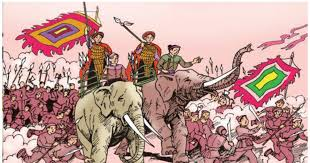
thuongBetween 218 and 208 BC, the Qin army led by General Đồ Thư, with 500,000 troops, expanded southward and invaded our country. Under the leadership of Thục Phán, the Tây Âu and Lạc Việt people fought heroically and defeated the Qin. Subsequently, Thục Phán replaced the Hùng King, established the Âu Lạc state (a combination of the Tây Âu and Lạc Việt groups), and moved the capital from Bạch Hạc (Phong Châu) to Phong Khê (Cổ Loa, Đông Anh). Thục Phán ascended the throne as An Dương Vương. Although Âu Lạc existed for only a short time (about 30 years), the Văn Lang and Âu Lạc eras are grouped together as the Period of National Construction.
thuongDuring the Âu Lạc period, due to the urgent need to fight foreign invaders, the people of Hanoi made extraordinary progress in military technology. They cast numerous bronze arrowheads and, notably, invented a crossbow capable of firing multiple bolts at once, known as the Liên Châu crossbow (referred to in legends as the "Magic Crossbow"). Significantly, this period saw the successful construction of Cổ Loa Citadel, a famous military architectural work that reflected the development of the Âu Lạc state. This was both a political and a military fortress.
thuongIn the early years, under An Dương Vương's leadership and aided by superior weapons and a sturdy citadel, the residents of Hanoi repeatedly repelled invasions by Triệu Đà. After multiple failures, Triệu Đà resorted to bribing talented generals, sowing internal division, and sending his son as a son-in-law to Âu Lạc to steal military secrets. An Dương Vương mistakenly lost his vigilance, failing to recognize the enemy's guile, leading to the loss of the "Magic Crossbow" and the downfall of his empire. Both folk tales and excavated remains at Cổ Loa demonstrate that the people of Hanoi during the Âu Lạc era fought resiliently against foreign invaders to protect their homeland
thuongSummary, from prehistoric times to the period of national construction, the land of Hanoi early on became a stable habitat for the ancient Viet people. Rich archaeological sites across the Paleolithic, Neolithic, Bronze, and Iron Ages show that people here not only knew how to master nature but also progressively developed their economy, culture, and technology. From the Phùng Nguyên, Đồng Đậu, and Gò Mun cultures to the Đông Sơn culture, Hanoi gradually formed into a densely populated and highly creative space. During the Văn Lang - Âu Lạc period, Hanoi served as a vital territory, associated with numerous legends and iconic historical works like Cổ Loa Citadel. These foundations created the essential premises for Hanoi to become the country's political, economic, and cultural center in subsequent historical periods.
-----------------------
References
1. Phan Huy Lê (Ed.), 2012, History of Thăng Long - Hanoi, Vol. 1, Hanoi Publishing House, p. 114.
2. Việt sử lược, 1960, Q.I -1a, Translation, Văn Sử Địa Publishing House, p. 14.
3. Nguyễn Quang Ngọc (Ed.), 2018, Hanoi Studies Textbook, VNU Publishing House.
4. Data source at the Hanoi Studies Space, Thủ Đô University.