 Làng nghề
 Di tích văn hóa & lịch sử






♦ PhD. Le Thi Thu Huong
(next and end)
* Thang Long during the Ly and Tran Dynasties
During the Tran dynasty, the imperial capital of Thang Long repelled three invasions by the Mongol - Yuan forces.
The First War of Resistance: The Victory at Dong Bo Dau (1258)
In the thirteenth century, Mongol cavalry forces appeared across vast regions of the world, including East Asia, Central Asia, West Asia, and Eastern Europe. The Mongol army, led by Khubilai Khan (Hot Tat Liet), conquered the northern half of China and prepared plans to attack Dai Viet as a stepping stone for a further northern campaign aimed at destroying the Southern Song dynasty. Before entering Dai Viet, the Mongols repeatedly dispatched envoys to Thang Long to demand the submission of King Tran Thai Tong. However, the king showed no fear and ordered all Mongol envoys to be imprisoned. At the same time, he commanded the entire country to prepare weapons and mobilize for resistance against the Mongol forces. Tran Quoc Tuan was appointed commander-in-chief of the army. At the end of 1257, the Mongol general Uryankhadai (Ngot Luong Hop Thai) led approximately forty thousand cavalry troops into Dai Viet, advancing by land along the Red River toward Thang Long. Facing an overwhelmingly strong enemy, the king decided to withdraw from the capital in order to preserve military strength. This strategic retreat of both the army and the royal court was carefully planned. Despite the withdrawal, the fighting spirit of the Tran court remained unshaken, supported by loyal and patriotic officials. Tran Thu Do, with his famous declaration, “As long as my head has not fallen, Your Majesty need not worry,” reinforced the resolve and determination of the Tran leadership, embodying the will of the entire army and people of Dai Viet at that time. When the Mongol forces entered Thang Long, they found an empty capital, with only a few imprisoned envoys remaining. Enraged, the invaders ravaged the city and burned palaces in retaliation. Soon, however, the Mongol army fell into severe shortages of provisions for both soldiers and horses. They were forced to plunder surrounding areas, where they encountered persistent resistance from the inhabitants of suburban villages. A notable example was the defensive battle fought by the villagers of Co So (present-day Duong Hoa Commune, Hanoi), whose determined resistance compelled the Yuan forces to halt their advance.
Lacking provisions after entering Thang Long, the enemy did not dare to station troops within the capital, nor could they disperse their forces. Instead, they established their camp at Dong Bo Dau wharf (present-day Hang Than Street, Ba Dinh Ward). Their strategy of achieving a rapid victory and sustaining their army through on-site plundering failed, forcing them into a defensive standstill. Seizing this opportunity, King Tran Thai Tong and Grand Preceptor Tran Thu Do consulted with their generals and launched a surprise attack against the enemy. The Tran forces were divided into two wings - naval and land - assaulting the enemy’s main encampment. Caught off guard, the Mongol troops fled in disarray; some were unable to don their armor, and others could not even saddle their horses, retreating toward Yunnan, China. During their retreat, upon reaching Quy Hoa camp (Phu Tho), they were again defeated by local militia forces under the command of Ha Bong. Thus, after nine days of occupying Thang Long, the Mongol army suffered a complete defeat.
The victory at Dong Bo Dau has resonated enduringly in the history of the imperial capital of Thang Long. It became a profound source of pride and a powerful encouragement for the military and people of Thang Long, as well as for the population of the entire country, strengthening confidence for continued successes in subsequent battles.
The Second War of Resistance against the Mongol–Yuan (1285): The Chuong Duong–Thang Long Campaign (June 1285)
After the destruction of the Southern Song dynasty in China, Khubilai Khan ascended the throne and established the Yuan dynasty (1271 - 1368). Seeking a pretext for launching a war of aggression, the Yuan court increasingly applied diplomatic pressure, issuing threats and even attempting to coerce the Tran court into submission.
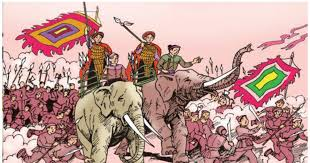
Facing the imminent threat of war, the court and the people made comprehensive preparations for resistance. In 1282, the Tran king convened the Binh Than Conference, bringing together princes and military commanders to deliberate strategies for defense and combat against the Yuan forces. At the Binh Than Conference, previous internal tensions among the Tran aristocracy were resolved, and all parties united in their determination to defend the country. Although still very young and therefore not permitted to join the campaign, Tran Quoc Toan famously crushed an orange in his hand and returned home to raise his own forces, marching under a banner embroidered with the six characters “Pha cuong dich, bao hoang an” (“Crush the powerful enemy, repay the emperor’s favor”). This act deeply moved contemporaries. Subsequently, at Dien Dien Hong in the imperial capital of Thang Long, the king summoned elders from across the country to deliberate on plans for resisting the invaders. Hung Dao Vuong (Prince of Hung Dao) Tran Quoc Tuan was appointed Quoc cong Tiet che (Grand Prince and Commander-in-Chief), assuming supreme command of the armed forces, and promulgated the Hich tuong si (Proclamation to the Officers and Soldiers), which rallied determination for resistance throughout the army. The proclamation resounded as an earnest call of the nation, stirring countless hearts and inspiring a powerful martial spirit that urged all to rise up against the enemy.
In 1285, approximately 600,000 Yuan troops advanced into Dai Viet along three directions. Facing an overwhelmingly strong enemy, for the second time the Tran court withdrew from the imperial capital of Thang Long. By the summer of 1285, as the Yuan forces penetrated deeper into the country, they were subjected to ambushes and attrition inflicted by the Tran leadership and the people. At the same time, suffering from intense heat, unfamiliar environmental conditions, illness, and shortages of provisions, the Yuan army weakened significantly. This created favorable conditions for the Tran forces to counterattack and recapture the imperial capital of Thang Long. Prominent in the second war of resistance against the Yuan at Thang Long were the victories at A Lo and Tay Ket–Ham Tu, associated with the contributions of Tran Nhat Duat, Tran Quoc Toan, and others, and especially the Battle of Chuong Duong, achieved through the leadership of Tran Quang Khai. The Việt sử Thông giám cương mục records: “Previously, the Supreme Commander Quang Khai and Hoai Van hau Quoc Toan led the army and the people to attack the regional routes, defeated the Yuan forces at Chuong Duong, and recovered the imperial capital”[1]. The resonance of these military achievements by the Tran rulers and their officials continued to echo in the poem Tụng giá hoàn kinh (Ode on the Emperor’s Return to the Capital) by Tran Quang Khai:
"Đoạt sáo Chương Dương độ
Cầm Hồ Hàm Tử quan
Thái bình tu trí lực
Vạn cổ thử giang san"
(Chương Dương cướp giáo giặc
Hàm Tử bắt quân thù
Thái bình nên gắng sức
Non nước ấy ngàn thu).
We wrested the enemy’s weapons at Chuong Duong,
We took the invaders captive at Ham Tu Pass.
Now that peace is restored, let us strive with all our might,
That our mountains and rivers may last forever.
The Third Resistance War against the Yuan - Mongol Invasion (1287 - 1288)
After suffering two defeats, Khubilai Khan once again organized a third invasion of our country. Unlike the previous two campaigns, this time the Yuan forces included a naval contingent carrying ample supplies. In this third invasion, the Yuan army mobilized the full strength of the empire, determined to conquer our land.
Drawing on the rich experience gained from the previous two wars of resistance, in the third campaign the Grand Prince and Commander-in-Chief Prince of Hung Dao, Tran Quoc Tuan proactively formulated the strategy to defeat the enemy. In this third resistance war, the entire court entered the struggle with strong determination and confidence. Once again, for the third time, the Tran dynasty’s king and officials, together with the people, withdrew from the imperial capital of Thang Long.
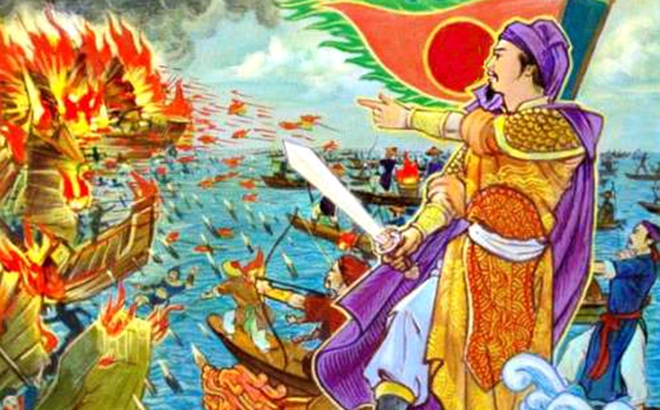
When the enemy’s supply convoy commanded by Zhang Wenhu was defeated by the Tran dynasty’s deputy commander Tran Khanh Du, the enemy panicked and began to retreat. Toghon (Thoat Hoan) had stationed his troops in the imperial capital of Thang Long for 32 days before also being forced to withdraw to Van Kiep. On the route from Van Kiep back to their country, both the land and naval forces of Toghon were intercepted and attacked by the army and people of Dai Viet. Most notably was the battle on the Bach Dang River. Under the command of the Grand Prince and Commander-in-Chief Prince of Hung Dao, fire attacks were combined with the rising tide, while submerged wooden stakes lay hidden beneath the water, resulting in the complete destruction of the enemy’s naval force. This victory demonstrated the brilliant military genius of Tran Hung Dao and the creativity of the people, who consistently knew how to inherit and apply the experience of their forebears in the struggle to defend the nation’s independence.
In the 13th century, Thang Long was devastated three times by the Mongol - Yuan armies. Although the king and his court had to withdraw from the imperial capital, the lesson of unity and determination of the entire army and population - under the leadership of a capable and effective command - proved that such strength can defeat any enemy. This lesson remains true in every era.
Thang Long during the Ho Dynasty
At the end of the 14th century, the Tran dynasty declined, and political upheavals led the economy and society into a state of crisis and disorder. In this context, the chancellor Ho Quy Ly deposed Emperor Tran Thieu De, seized the throne, and established the Ho dynasty (1400 - 1407).
Before ascending the throne, from the spring of 1397, Ho Quy Ly ordered the construction of a new capital at An Ton (Vinh Loc, Thanh Hoa). After three months, the work was completed, and Ho Quy Ly brought Emperor Tran Thuan Tong to reside there. The new capital was called Tay Do (Western Capital), while Thang Long was renamed Dong Do (Eastern Capital). Although it lost its position as the political center of the country, Thang Long - Dong Do remained the largest and most important center of the nation, a place where people from all directions converged. Moreover, Tay Do, being “located in a cramped, remote area, at the end of the country and the beginning of the mountains,” was primarily a military stronghold and therefore could hardly replace the status of Dong Do.
From 1010 to 1400, Thang Long went through many major upheavals in the nation’s history, closely associated with the prosperity and trials of the Ly and Tran dynasties and the transition to the Ho dynasty. Not only a political and military center, Thang Long was also a place where the intelligence, resilience, and patriotic spirit of the people of Dai Viet were crystallized. Despite being repeatedly devastated by wars, Thang Long always stood firm, affirming its enduring vitality and its irreplaceable role in the course of history. It is precisely these historical, cultural values and the tradition of steadfast struggle that have shaped the unique and enduring position of Thang Long-Hanoi throughout the long span of the nation’s history./.

Ridge-end roof tiles decorated with lotus-leaf motifs featuring phoenix designs, Ly dynasty (11th - 12th centuries)
Source: National Museum of History
------------------------------------
[1] Việt sử thông giám cương mục, Vol. 1, ibid., p. 524.