 Làng nghề
 Di tích văn hóa & lịch sử






♦ Prof.PhD. Nguyen Quang Ngoc
(Vietnam National University, Hanoi)
Imperial Consort Y Lan’s Contributions to the Dai Viet State
The Ly dynasty and the Dai Viet state in the late 11th and early 12th centuries (under Kings Ly Thanh Tong and Ly Nhan Tong) developed to a brilliant peak. Their achievements in both civil governance and military accomplishment owed an exceptionally significant contribution to Imperial Consort Y Lan.
She was the figure who maintained stability and elevated the dynasty under the most difficult and complex circumstances.
From the At Mao year (1075) to the Dinh Ty year (1076), when Ly Nhan Tong was only ten years old, the country faced severe attacks from Champa in the south, while the Song forces twice marched south to invade from the north. Ly Thuong Kiet served as supreme commander on both the northern and southern fronts. Meanwhile, Imperial Consort Y Lan, together with Grand Preceptor Ly Dao Thanh, devoted themselves to managing court affairs and the home front, enabling the country and the dynasty to overcome a grave trial. They organized a resounding and successful resistance against the Song, preserved the integrity of national territory, and helped open the tradition of expanding and consolidating the southern frontier of the Vietnamese nation - so that Vietnam could possess the full territories and maritime spaces it has today.
Born into a poor farming family, Imperial Consort Y Lan deeply understood and sympathized with the suffering of ordinary people. She allocated state treasury funds to redeem women who, because of poverty, had been forced to sell themselves or pledge their bodies as debt security, and then took responsibility for helping them build stable, happy families. She repeatedly reminded the king to care for the people, and to punish heavily those who stole or slaughtered buffaloes, because “the buffalo is the head of one’s livelihood” - the vital resource sustaining life and production for poor farming households. She was also highly learned and exceptionally capable, with profound understanding of Buddhism. Directly or indirectly, she contributed resources and intellect to the construction of more than one hundred pagodas, helping raise public knowledge and ushering in a period of flourishing Buddhism. She likewise played an important role in bringing Thang Long culture and Dai Viet civilization to a brilliant high point - especially through people-centered governance and the elevation of women’s roles.
The Legacy of Imperial Consort Y Lan in Hanoi
Imperial Consort Y Lan was born and raised in Hanoi, and her entire life and career were closely associated with the Ly dynasty and with Thang Long - Hanoi. Therefore, the legacy she left to later generations is concentrated mainly within Hanoi.
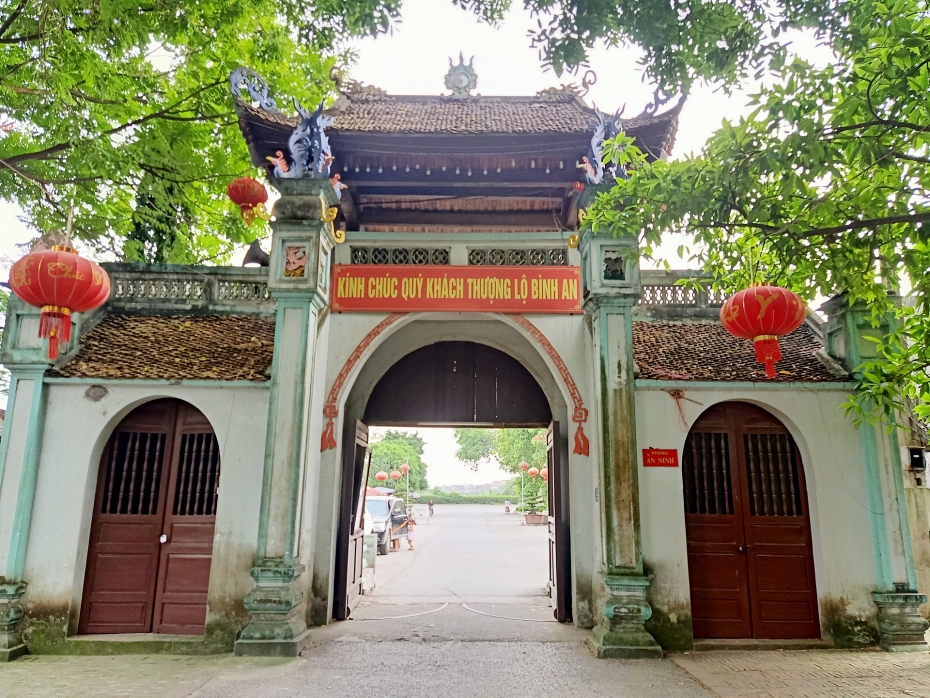
Today, Hanoi has many sites dedicated to the worship of Imperial Consort Y Lan, most densely in Gia Lam, her homeland. These include Den Ba Tam (Duong Xa, Gia Lam - where she was born), Chua Nanh (Ninh Hiep), Dinh Ngoc Dong, and Den Duc Ly Thai Hau (Phu Thi), among others. Dinh Yen Thai (Tam Thuong alley) in Hoan Kiem ward also worships Imperial Consort Y Lan. According to tradition, although she lived amid royal splendor, Y Lan never forgot the poor. She often distributed rice and grain to those in need. A devoted Buddhist, she favored charitable acts and founded many communal houses and pagodas. She frequently visited religious sites, exchanging views with monks and nuns who preached Buddhist teachings. She had a Buddhist shrine built in Kim Co ward, along with hundreds of pagodas across the country - many of them concentrated in Hanoi[1].
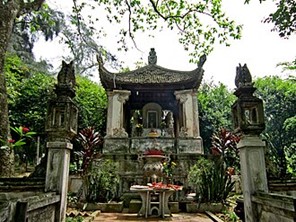
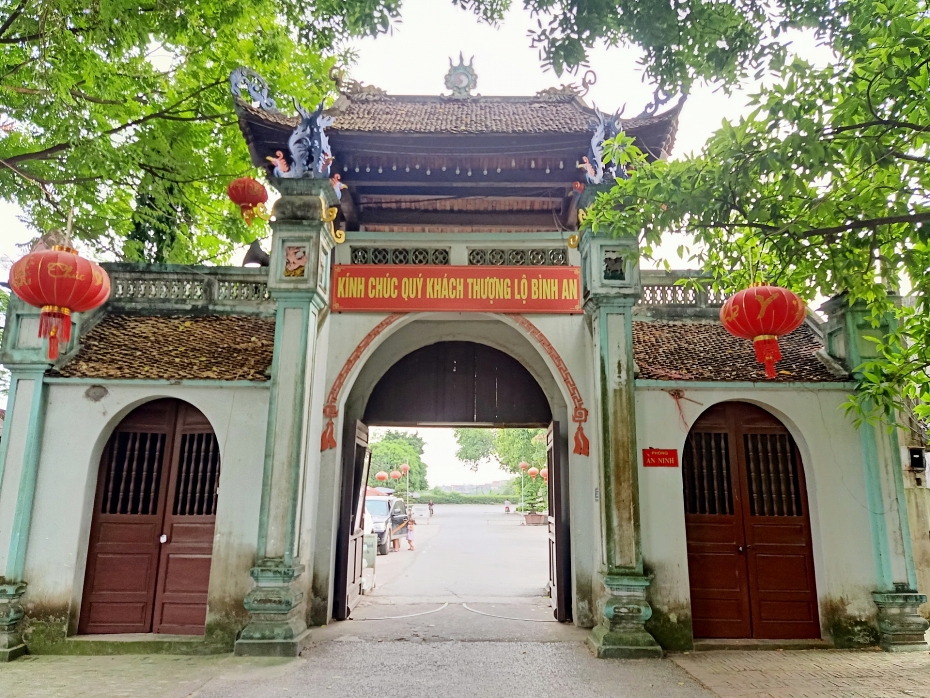
The temple complex in Duong Xa commune is regarded as the principal and oldest worship site (built in 1115). It still preserves and protects ancient relics across nearly nine centuries, including three lotus-petal carved stone bases, two stone lion heads, and a phoenix-bird stair edging dating to the Ly period; four stone steles from the Later Le period; and a wooden altar-shrine carved with coiling, saddle-shaped dragons, with openwork motifs of sacred creatures from the Mac period.
Among these, the most distinctive are the two stone lions carved in a prostrating posture while “playing with a pearl.” Their lines are notably soft and supple, giving the “lord of the forest” a beauty both graceful and powerfully imposing. The large protruding eyes sit beneath thick brows; the teeth are evenly set, with sharp and strong fangs; and the thick legs end in curved, sharp claws gripping tightly. At the same time, the “lion playing with the precious pearl” posture evokes flexibility and fluid motion. Perhaps it is precisely this combination that gives the artifact its spirit and character. The statue of Imperial Consort Y Lan is finely carved and placed within a large wooden shrine, conveying the benevolence and compassion of a sacred mother figure of northern Vietnam. Den Ba Tam is not only the most ancient and revered site dedicated to Imperial Consort Y Lan, but also a place that preserves cultural and architectural values spanning from the Ly era through later periods.

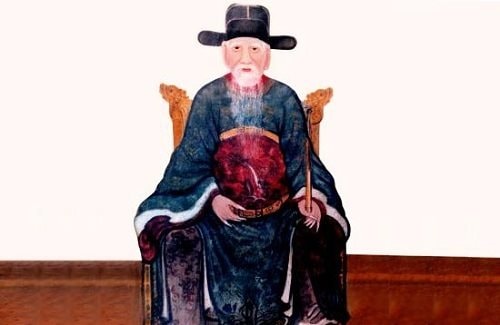
Statue of Imperial Consort Y Lan at Den Ba Tam (Gia Lam, Hanoi)
On the 25th day of the 7th lunar month in the Dinh Dau year (24 August 1117), Empress Dowager Y Lan passed away. She was cremated and posthumously granted the title Phu Thanh Linh Nhan Hoang Thai Hau. Her remains were interred at Tho Lang, Thien Duc prefecture (Tu Son ward, Bac Ninh Province).[2] The people of Kim Co ward transformed the Buddhist shrine into a place of worship for her, venerating her as a tutelary deity (thanh hoang) and maintaining incense offerings for generations.
Y Lan rose from a village girl to become Imperial Consort to King Ly Thanh Tong, and later Empress Dowager Linh Nhan under Emperor Ly Nhan Tong. Twice she held the reins of government in the king’s stead, implementing policies to secure the people and govern the realm, guiding the dynasty and the country through countless dangers, and opening an era of peace and prosperous rule - brilliant in both civil administration and military achievement - reaching the heights of monarchical civilization of the age. Together with the Hai Ba Trung, Imperial Consort Y Lan stands as a representative woman of Hanoi across all eras. She is also among the most outstanding embodiments of the Vietnamese women’s tradition of heroism, resilience, fidelity, and capability.
[1] Nguyen Vinh Phuc. Nguyen Duy Hinh (2009), The Tutelary Gods and the Religion of Thang Long - Hanoi, Publishing House. Labor, Hanoi, pp. 277-279.
[2] It is possible that, during her lifetime, after Emperor Ly Thanh Tong passed away, she returned to live in Dong Nhan Palace within the Forbidden City of Thang Long (today the area of the National Assembly Office, 62–64 Tran Phu Street) and died there. Emperor Ly Nhan Tong designated Dong Nhan Palace as the place where she would be worshipped. In 1127, Ly Nhan Tong died. His adopted son, Duong Hoan, ascended the throne, elevated his father Sung Hien Hau to Thai Thuong Vuong (Retired Emperor), honored his mother Do Thi as Thai Hau (Empress Dowager), and brought her to reside at Dong Nhan Palace. Perhaps for that reason, the shrine dedicated to Imperial Consort Y Lan was moved to Hong Tan giai (nhai)—that is, the area corresponding to present-day Buoi. At the confluence (tri-junction) of the Thien Phu and To Lich rivers, traces of her activities remain deeply etched in the collective folk memory.