 Làng nghề
 Di tích văn hóa & lịch sử




♦ Dr. Le Thi Cuc
thươngBuddhism is a major religion in Vietnam, possessing a long history and a profound influence on the lives of the Vietnamese people. In Hanoi - a land inextricably linked to the history of Thang Long - Buddhism took root prior to the Ly Dynasty, flourished brilliantly under the Ly and Tran eras, maintained its practice through the Le and Nguyen dynasties, and continues to play a vital role in the spiritual life of modern Hanoians. Through a system of pagodas, festivals, and religious activities, Buddhism has deeply impacted the ideology, ethics, lifestyle, and customs of Hanoi's inhabitants.
The History of the Formation and Development of Buddhism in Hanoi
thươngBuddhism originated in India and subsequently spread to Eastern nations, including Vietnam. It likely entered Vietnam around a few centuries before or after the Common Era. Although scholarly consensus is still pending, historical records suggest that Buddhism was first introduced to Vietnam around the 2nd century. At that time, Indian monks followed merchant ships via maritime routes to Luy Lau (the Dau region), now in Thuan Thanh - Bắc Ninh, forming the Dau Buddhist lineage. “This was the Viet - Indian Buddhist foundation that existed before the introduction of Chinese Buddhism.” [1] From the 9th century with the establishment of the Kien Sơ lineage at Kien Sơ Pagoda [2] to the 13th century with the birth of the Truc Lam Zen sect, Buddhism in Hanoi gradually defined its identity and developmental trends throughout history.

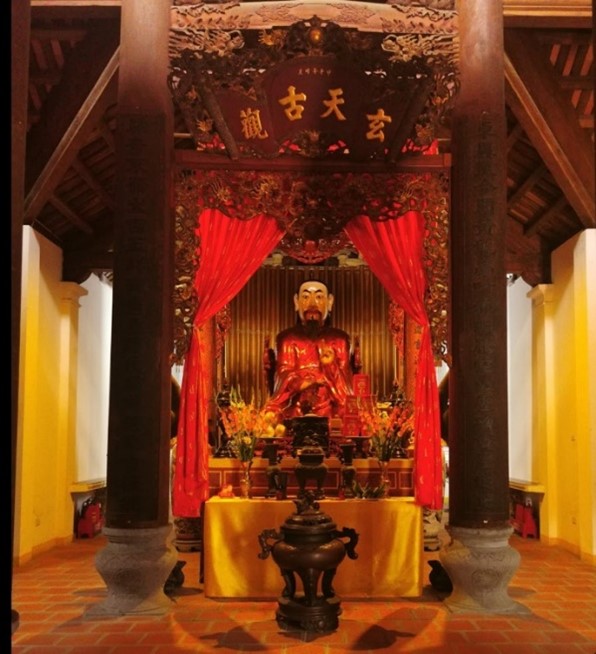
The Statue of Zen Master Vo Ngon Thong at Kien So Pagoda (Collected Photo)
thươngAlthough Hanoi was not the primary site of Buddhist entry, its developmental milestones can be traced back to the Ly Dynasty. To date, Buddhism in Hanoi has experienced various periods of prosperity and decline. Its presence in Thang Long – Hanoi is associated with monks who were either natives of the city or those who, despite being born and ordained elsewhere, made significant contributions to the faith’s growth in the capital.
thươngDuring the Ly Dynasty, Buddhism flourished in Thang Long - the nation’s political, economic, and cultural heart. The Ly kings were devout, transforming Buddhism into an ideology linked to statecraft. Famous Zen masters of this era included Vạn Hanh and Đa Bao. Thang Long became a hub for many sects, particularly the Kien So lineage, alongside the development of other lineages and Esoteric (Mantrayana) thought, as well as the worship of Indra (Đế Thích) and Avalokitesvara. The phenomenon of "The Three Religions Sharing the Same Source" (Tam giáo đồng nguyên) emerged, yet Buddhism held the advantage while absorbing significant influences from Chinese Buddhism, evident in metaphysical theories such as "Being - Non - being" (Hữu - Không) and "One Vehicle" (Nhất Thừa).
thươngDuring the Tran Dynasty, Buddhism continued to hold the status of a national religion. While the Lý kings built many state pagodas (quốc tự) in Thang Long, the Tran kings focused their constructions in Yen Tu. The Thao Đuong sect - a Chinese Zen lineage - appeared during the Ly era. The Dau and Kien So lineages gradually merged into a unified Zen sect. Although Thang Long had many monks of aristocratic origin, including kings, it was initially the second-largest Buddhist center after the Dau region. However, “By the Tran era, the Yen Tu Buddhist center of the Tran kings became the primary center, overshadowing others because a King-Buddha became the patriarch of the Truc Lam Sect.” [3] In the context of the resistance against the Yuan-Mongol invasions, Buddhism in Thang Long emphasized independence; while fewer new pagodas were built, it remained crucial to spiritual life.
thươngIn the Early Le Dynasty, Confucianism assumed the dominant position, causing Buddhism in Thang Long to reside primarily in folk life rather than the royal court. The court focused on building the Temple of Literature (Văn Miếu), doctoral stelae, and the examination system. Nevertheless, Buddhist activities persisted through the restoration of pagodas like Thanh Đàm and Chieu Do. By the Restoration Le period (17th century), Buddhism saw a resurgence, although Confucianism remained the primary social ideology.
thươngFollowing the establishment of the Nguyen Dynasty and the relocation of the capital to Hue, Hanoi transitioned from a political center to a provincial city. Huế became the nation’s Buddhist center. The Nguyễn emperors somewhat restricted Northern Buddhism due to the influence the Le kings and Trịnh lords had over its clergy. Consequently, while Buddhism flourished in Hue and other provinces, it was somewhat limited in Hanoi, with significantly fewer pagodas built compared to the new capital.
thươngIn the late 19th and early 20th centuries, as Vietnam became a French colony and Hanoi served as a crossroads of East-West culture, Buddhism entered a modern period of upheaval. From the 1930s, Hanoi’s clergy actively participated in the Buddhist Revival Movement (Chấn hưng Phật giáo), notably with the founding of the Tonkin Buddhist Association (1934) and monastic organizations at Quán Sứ Pagoda, gradually re - affirming Hanoi’s status. In 1942, the North Vietnam Monastic Reform Association [4] was also established at Quan Su Pagoda.
thươngSince 1945, especially following national reunification, Vietnamese Buddhism has gradually unified its organizational structure nationwide. From 1981 to the early 21st century, numerous National Congresses of the Vietnam Buddhist Sangha were held in Hanoi (1981, 1987, 1992, 1997, 2002...), affirming the capital's role in contemporary Buddhist life, with Quan Su Pagoda serving as the nation's Buddhist headquarters.
Characteristics of Buddhism in Hanoi
thươngThroughout its long history, Buddhism in Thang Long - Hanoi has developed distinct traits typical of Northern Buddhism: Mahayana Tradition with Theistic Tendencies: Upon its entry into Vietnam, Buddhism adopted Mahayana sutras and early on associated the Buddha image with divine elements (theism) to meet the religious needs of the community. In the Mahayana view of that era, Shakyamuni Buddha was divinized. Vietnamese Buddhist philosophy is categorized as a form of theistic philosophy.
thươngFolk Buddhism over Scholastic Buddhism: In Thang Long - Hanoi, folk Buddhism is more deeply embedded in the communal psyche than academic Buddhism. It does not emphasize complex metaphysical depth but rather the philosophy of "saving beings from suffering" (cứu khổ cứu nạn). Avalokitesvara Bodhisattva (Quan Thế Âm) is widely worshipped for practical needs such as praying for rain, children, or peace. To this day, many Hanoi pagodas (such as Huong Pagoda) maintain altars for Cô and Cậu (Holy Maidens and Lads) where people pray for progeny.
The Role of Buddhism in Hanoi
thươngIn Thang Long – Hanoi, the pagoda holds a central position in the cultural and spiritual life of the Vietnamese. Through a system of temples and religious activities, Buddhism profoundly influences ideology, ethics, and customs. From the Ly era, Thang Long became a vital Buddhist center alongside Luy Lau. Today, many ancient pagodas remain: Tran Quoc, Dien Huu (One Pillar), and Phuc Khanh in the inner city; and Đau, Boi Khe, Huong, Tram Gian, Tay Phuong, and Thay pagodas in the expanded Hanoi region. This reflects the endurance of Buddhism in the capital's cultural fabric.

Tran Quoc Pagoda (Collected Photo)
thươngIntertwined with the formation and development of Thang Long – Hanoi, Buddhism is not merely a major religion but a crucial component of Hanoi’s cultural identity. In the current context of urbanization and modernization, correctly identifying the historical role of Buddhism in Hanoi is essential for preserving and promoting Buddhist cultural heritage, thereby maintaining the essence of Thang Long - Hanoi in contemporary life.
----------------------------------------------------------------
[1] Nguyen Duy Hinh (2006), Vietnamese Buddhist Philosophy, Culture and Arts Publishing House, p. 20.
[2] Kien So Pagoda is now located in Phu Đong, Gia Lam, Hanoi.
[3] Collection of a Thousand Years of Thang Long Civilization, Vol 2, Culture and Information Publishing House, p. 2686.
[4] In 1945, the North Vietnam Monastic Reform Association was renamed the Tonkin Sangha Association.
----------------------------------------------------------------
References
1. Nguyen Viet Chuc, Nguyen Vinh Phuc (Eds.) (2017), Encyclopedia of Hanoi - Expanded Hanoi Section, National Political Publishing House, Hanoi.
2. Nguyen Duy Hinh (2006), Vietnamese Buddhist Philosophy, Culture and Arts Publishing House, Hanoi.
3. Collection of a Thousand Years of Thang Long Civilization, Vol 2, Culture and Information Publishing House, Hanoi.
4. Mai Tho Truyen (2007), Buddhism in Vietnam, Religion Publishing House, Hanoi.
5. Hai Thanh, Kien So Pagoda and the Vo Ngon Thong Zen Lineage, Buddhist Research Magazine, Sep 2017.