 Làng nghề
 Di tích văn hóa & lịch sử




♦ Dr. Le Thi Cuc
thuongLang Pagoda stands as a preeminent monument of Thang Long – Hanoi. Constructed during the Lý Dynasty—a period marked by the flourishing of Buddhism that profoundly influenced architecture, ideology, and social life—Láng Pagoda is more than a religious edifice. It is a space that crystallizes Lý-era culture, inextricably linked to the Zen Master Từ Đạo Hạnh.
Historical Origins of Lang Pagoda and the Legend of Zen Master Từ Đạo Hạnh
thuongLang Pagoda is also known by other names such as Chiêu Thiền Tự or Chùa Cả (The Great Pagoda). According to the Tục Lệ (Customary Law) stele preserved at the temple, it was built during the reign of King Lý Anh Tông (1138–1175). The formation of the pagoda is tied to Zen Master Từ Đạo Hạnh, a legendary figure in Vietnamese Buddhist history who left behind a rich legacy, particularly in culture, belief systems, and medicine. He is revered as a dhyana master and a practitioner possessed of miraculous powers. The local populace venerates him as Đức Thánh Láng (The Holy Sage of Láng), worshipping him with the status of a deity.
thuongSome records suggest that Từ Đạo Hạnh belonged to the 12th generation of the Vinitaruci Zen school. According to hagiography, he was considered the son of Sùng Hiền Hầu and was later reincarnated as King Lý Thần Tông. Tradition holds that while Từ Đạo Hạnh was reborn as King Lý Thần Tông, Zen Master Giác Hải (or Giác Hoàng) was reborn as the monk Đại Điên [1]. The Đại Việt Sử Ký Toàn Thư (Complete Annals of Đại Việt) records the life of Zen Master Từ Đạo Hạnh as follows: “Year of Bính Thân, [Hội Tường Đại Khánh] 7th year [1116], (Song Dynasty’s Zhenghe 6th year). In the summer, the monk Từ Đạo Hạnh discarded his mortal coil at the temple on Thạch Thất mountain. Previously, the wife of Sùng Hiền Hầu, Lady Đỗ, had been pregnant for a long time without giving birth. The Marquis remembered Đạo Hạnh’s prior instructions and sent a messenger on horseback. Đạo Hạnh immediately changed his robes, bathed, entered a mountain cave, cast off his mortal remains, and passed away. Subsequently, the Lady gave birth to a son, namely Dương Hoán.” [2] Owing to this legend, Lý Thần Tông’s son, Lý Anh Tông, commissioned the construction of Chiêu Thiền Pagoda to worship his royal father (whose predecessor was Zen Master Từ Đạo Hạnh).
thuongLang Pagoda underwent numerous restorations in 1656, 1666, 1869, and 1901 [3]. Throughout successive dynasties, although its physical appearance has evolved, the pagoda remains at its original site, preserving the ancient aura of a premier scenic landmark of the Thăng Long citadel.
The Cultural Imprints of the Lý Dynasty at Lang Pagoda
• Tangible Cultural Imprints
thuongThe Lý-era cultural legacy at Lang Pagoda is manifested through both tangible and intangible values. Architecturally, the pagoda space carries the distinctive characteristics of Northern Vietnamese village temples, featuring a harmonious layout integrated with the landscape and communal life.
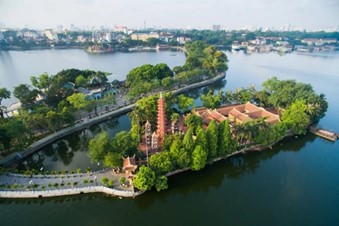
thuongLang Pagoda is a large-scale architectural complex organized in the traditional “nội công ngoại quốc” layout (Internal "Work" character/External "Country" character), reflecting the spatial logic characteristic of medieval Buddhist architecture. The ensemble includes primary categories: the Front Hall (Tiền đường), Square Pavilion (Phương đình), Middle Hall (Trung đường), Incense Burning Hall (Thiêu hương), and the Upper Sanctuary (Thượng điện). Flanking the Upper Sanctuary are corridors, while the rear houses the Bell House, the Gong House, the Mother Goddess Shrine, the Patriarch Hall, and a stupa garden, creating a self-contained, harmonious, and solemn space.
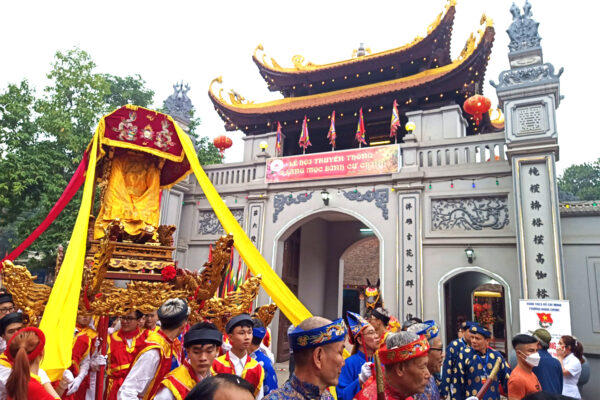
thuongThe architectural highlight begins with the pagoda gate, featuring four square pillars and three curved roofs attached to the sides, with the central roof elevated above the lateral ones—reminiscent of Lý Dynasty palatial architecture. Beyond the gate lies a spacious brick courtyard with a stone dais at its center for ceremonial palanquins. This is followed by the Tam Quan (Triple Gate) and an octagonal pavilion housing the statue of Zen Master Từ Đạo Hạnh. Only after the octagonal pavilion does one reach the main structures like the Ceremonial Hall, the Incense Burning Hall, the Upper Sanctuary, and the residential quarters.

The Gate of Lang Pagoda (Collected Photo)
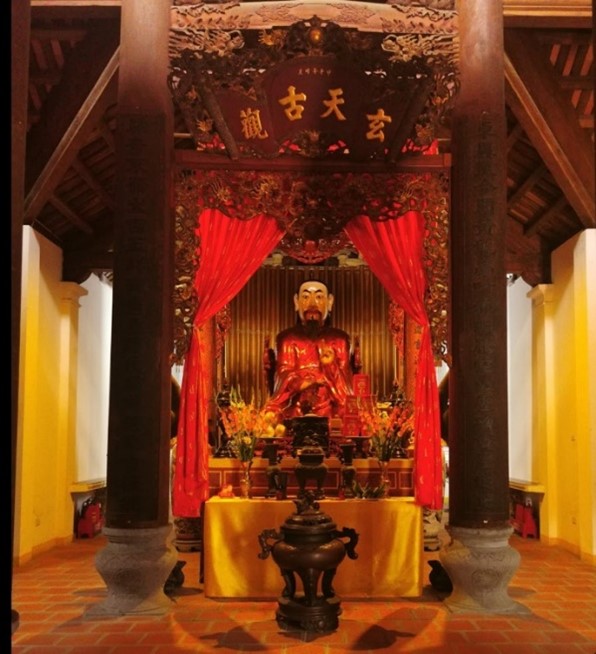
thuongCommensurate with its architectural scale is a diverse system of artifacts, including stelae, bronze bells, gongs, horizontal lacquered boards, parallel sentences, decorative canopies, royal decrees, and a system of statues, reflecting the continuous evolution of the monument. Most iconic is the statue of Zen Master Từ Đạo Hạnh in the octagonal pavilion. Legend says the statue dates back to the Lý era, was fundamentally restored during the Lê era (approx. 1644–1646), and underwent comprehensive restoration in January 2005.
thuongDespite various restorations, the sculptural elements and ritual arrangements at Lang Pagoda still preserve aesthetic traits deeply influenced by Lý Buddhism: a tendency toward ethereal, balanced forms and restrained ornamentation, harmonizing Buddhist symbols with indigenous beliefs. The statues, especially that of Từ Đạo Hạnh, embody the humanistic ideals of the Lý era, where humanity is placed at the center of spiritual life.
• Intangible Cultural Imprints
thuongLang Pagoda is a vessel for the spiritual values of ancient Thang Long. The intangible imprint is most vivid in the festivals and religious practices associated with the hagiography of Từ Đạo Hạnh, reflecting the syncretism between Buddhism and folk beliefs - a hallmark of Lý-era religion.
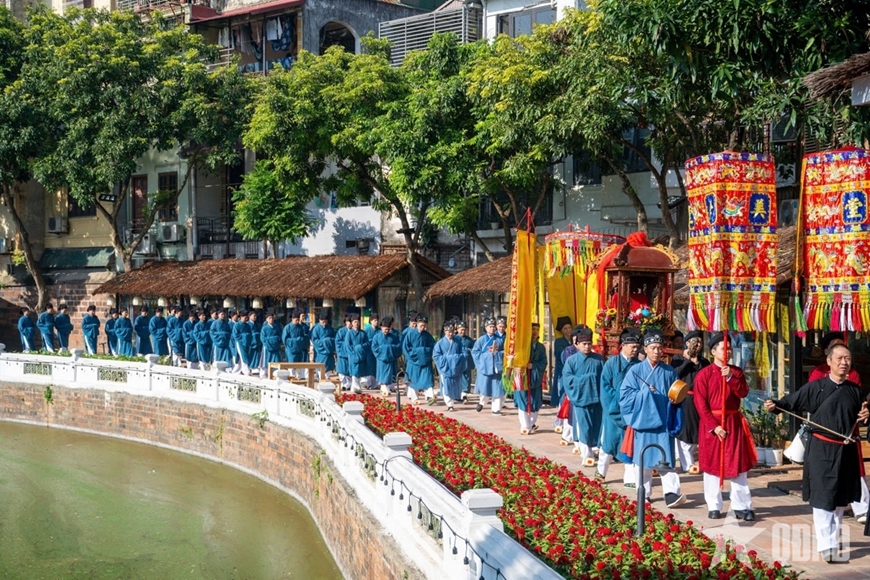
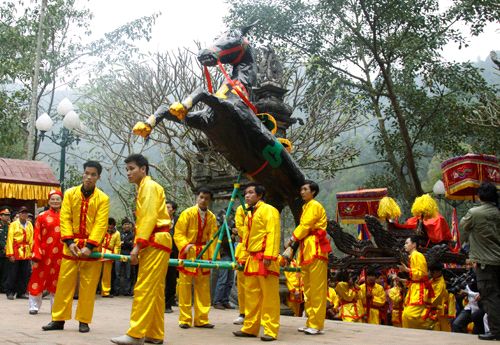
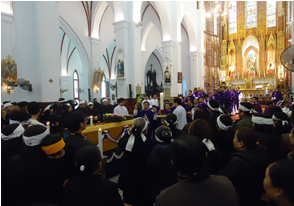
thuongThe Lang Pagoda Festival is held on the 7th day of the 3rd lunar month (the Master's birthday), featuring a palanquin procession from Lang Pagoda to Hoa Lang Pagoda (Dịch Vọng Ward), where his parents are worshipped. This demonstrates the tight bond between Buddhist worship, ancestral worship, and filial piety. The festival's cultural resonance is echoed in folk verses: “Remembering the seventh day of the third month / Return to the Lang Festival, head out to the Thầy Festival.”

Lang Pagoda Festival (Collected Photo)
thuongIn conclusion, Lang Pagoda is a monument profoundly marked by Lý-era culture and a crystallization of Lý Buddhist values. The figure of Zen Master Từ Đạo Hạnh remains central to the construction of the pagoda's historical and sacred meaning. From a historical monk, he has been elevated to a divine figure in folk belief, reflecting the dual nature of Lý Buddhism: linked to the royal court yet deeply integrated into village life. Today, Lang Pagoda continues its vital role as a symbolic historical-cultural relic of Hanoi, aiding modern generations in understanding the values of Lý Dynasty Buddhism and the significance of preserving national heritage.
--------------------------------------------
References
1. Tran Thị Tuyet Mai – Hanoi University of Culture (2022). The Cultural Beauty of the Huong Pagoda Festival in Former Times.
2. Thai Nguyen Newspaper (2009). Reflections from Huong Pagoda.
3. ACC Hanoi (2025). A Brief History of Huong Tich Pagoda, Hanoi.
4. Son Duong (2023). The Relic and Scenic Complex of Huong Son (My Duc District).
5. Nguyen Tri Son, M.A. (2006). Huong Tich Pagoda. Cultural Heritage Magazine, Issue 96.