 Làng nghề
 Di tích văn hóa & lịch sử






♦ Dr. Nguyen Thi Thanh Hoa
The festival of the five Mọc villages takes place on the 11th and 12th days of the second lunar month. This is not only a unique National Intangible Cultural Heritage but also a testament to the tradition of unity, solidarity, and mutual support, reflecting the deep-rooted bond and affection shared by the people of ancient Thang Long and modern-day Hanoi.
1. The villages of the Mọc area
Based on surviving local documents, the Mọc area was an early settlement of the ancient Viet people. By the 13th century, this region consisted of a belt of eight residential clusters (eight villages) collectively known as Kẻ Mọc, with the Sino-Vietnamese name Nhân Mục. The village of Hoà Mục separated early on to become its own commune. By the mid-17th century, the remaining seven villages formed two grassroots administrative units: Nhân Mục Cựu and Nhân Mục Môn, using the Lai Kinh Road (the main route from the West to the capital of Thang Long) as their boundary.
The Nhân Mục Môn Commune, situated adjacent to the Lai Kinh Road, comprised five villages: Lý (later renamed Giap Nhất), Quan Nhan, Hoa Linh (renamed Chinh Kinh from 1841 onwards to avoid a naming taboo regarding King Thiệu Trị’s mother, Lady Ho Thi Hoa), Cu Loc, and Phung Khoang (which was elevated to the status of a commune and transferred to the Thien Mo Canton in Tu Liem District in the fourth year of the Bảo Thái era (Year of Gui Mao, 1723); however, it continued to share in religious practices and festivals with the other Mọc villages).
Nhân Mục Cựu Commune was the eastern part of the Kẻ Mọc area, comprising two villages: Thuong Đinh (Mọc Thượng) and Ha Đinh (Mọc Cựu). According to the book “Quốc sư tạp lục” (Articles of national history) by Nguyễn Thieu Lau, the Ha Đinh villagers believed that the Vietnamese name "Kẻ Mọc" was later transliterated into the Sino-Vietnamese name "Mộc Cư" to describe this land of large, dense trees (Cự Mộc). It was later changed to Cự Lộc, reflecting the villagers' aspirations for a life of prosperity and good fortune. From Cự Lộc village, residents went on to settle and establish a livelihood in the other Moc villages.
Starting July 1, 2025, with the implementation of the two-tier administration model, four of the five Moc villages - Giap Nhat, Quan Nhan, Chinh Kinh, and Cu Loc - fall under Thanh Xuan Ward, while Phung Khoang village is part of Đai Mo Ward.
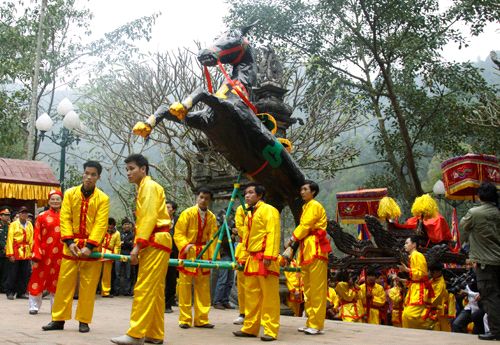
 The flying palanquin is always the sacred and mysterious highlight of the Festival of the Five Mọc Villages.
2. The Five Mọc Villages’ Festival
thuonThe Mọc spring festival has existed since ancient times, as captured in the folk verses:
The Mọc villages hold their festival in the second month
With processions on the eleventh and twelfth, clear as day
Great is the joy when the five villages open the feast
Inviting the whole world and every street to come and behold
There are incense altars and royal palanquins,
With troupes of dancers and drummers following in rhythmic harmony.
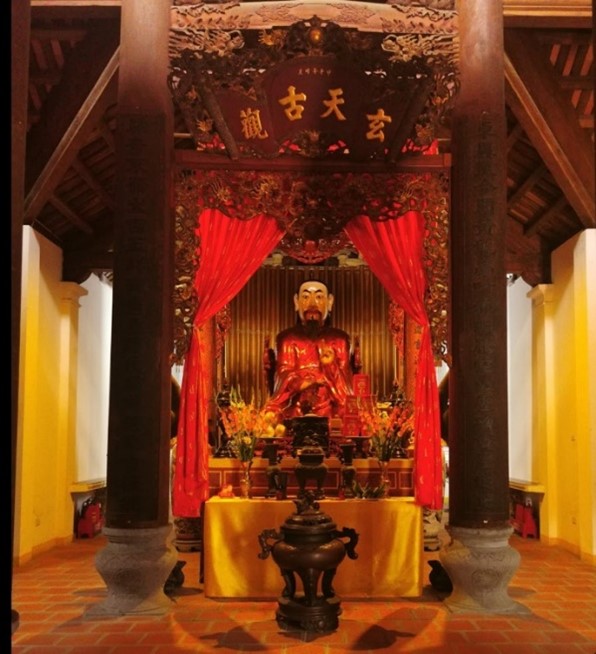
Legend has it that during a year of natural disasters, the local population was plunged into famine. The people of Phùng Khoang village were permitted by the King to cook porridge and rice balls to distribute to the hungry. A young boy, upon receiving a rice ball, shared it with four other boys. These five later became sworn brothers and settled in the area together, establishing the prosperous settlements that would become the five Mọc villages. The Five Mọc Villages’ Festival originated from the custom of "kết chạ" (becoming sworn siblings) between the villages of Giap Nhat, Chinh Kinh, Cu Loc, Quan Nhan, and Phung Khoang. Each of the five villages worships its own tutelary deity: Giap Nhat Village worships Phung Luong, a general under Vietnamese military leader Phung Hung (known to Vietnamese people as Bố Cái Đại Vương Phùng Hưng); Cự Chính Village (comprising Cu Loc and Chinh Kinh) worships Saint La Đai Lieu, a general under King Ngo Quyen; Quan Nhan Village worships Trung Nghĩa Đại Vương Hùng Lãng Công, who was credited with defeating the Nam Chiếu invaders and worshipped alongside his wife, the Lady Saint Trương Mỵ Nương; Phung Khoang Village worships General Đoàn Thượng, a loyal official from the Lý Dynasty.
The Five Mọc Villages’ Festival is a regional celebration along the Tô Lịch River. Prior to the administrative reorganization of the two-tier government, the festival was held across four communal houses located in two separate districts, including Giap Nhat, Cu Chinh, and Quan Nhan (within Nhan Chinh Ward, Thanh Xuan District) and Phung Khoang (within Trung Van Ward, Nam Tu Liem District).
Since 1992, the residents of the five villages have reached a consensus to hold a large-scale festival once every five years. The main event takes place on the 11th and 12th days of the second lunar month, with the host village rotating for each cycle. In the intervening years between these major festivals, each village conducts its own "hội lệ" (smaller annual rites) individually.
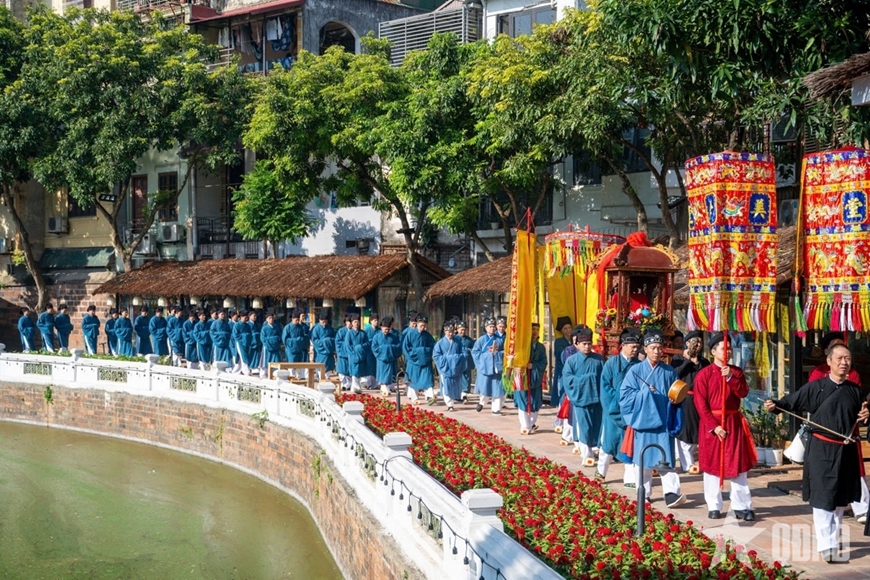
In preparation for the festival, local authorities and community representatives from the five villages convene to organize the event and perform essential rituals, such as the opening ceremony of the communal house, water procession, carpentry ceremony, and Buddha bathing ceremony (wearing Saint clothing). On the main festival day, the villages conduct a grand Saints’ Procession in a planned procession sequence: Leading the procession are five five-colored flags symbolizing the Five Elements, followed by flag dance team, dragon dance team, then drums, gongs, lion dance team, horses and elephant troupes, Bồng dance performers, incense altars, dragon palanquins, flag bearers, lỗ bộ (“Eight Treasures” or eight ceremonial weapons) team, bát âm (traditional octet ensemble), holy palanquin, bowl tribute palanquin, flower palanquin, bamboo-frame elephants, and wooden horses, and so on. Beyond the ceremonial rites, the Five Mọc Villages’ Festival also features many folk games such as human chess, hanging bridge, catching ducks under the pond, breaking the pot, hitting the plate, blind man's bluff, cock fighting, swinging, traditional poker, and wrestling; in the evenings, there are typically Chèo singing and Ả Đào (or Ca trù) singing performances; today, these are complemented by modern cultural and sporting activities, among others.
The most distinctive feature of the Five Mọc Villages Festival is the Water Procession ritual. Leading the way are five five-colored flags, followed in sequence by flag dance teams, drums, lion dancers, pink horse, white horse, Bồng dancers, and incense altars. These are followed by a procession of Buddhist followers, bát bửu, chấp kích (Eight Treasures” or eight ceremonial weapons), đồng văn (traditional Vietnamese musical ensemble), sinh tiền dancing (traditional clapper) dancers, bản drums (team playing small shoulder drums), dragon palanquins, lỗ bộ, bát âm (traditional eight-sound ensemble), holy palanquin, lion and dragon dance troupes, along with a vast gathering of villagers and visitors from all over.
After 1953, due to economic hardships, the Five Mọc Villages’ Festival was temporarily suspended and it was not until 1996 that the festival was revived. In 2021, the "Five Mọc Villages’ Festival" was officially recognized by the Ministry of Culture, Sports, and Tourism as a National Intangible Cultural Heritage.
--------------------------------------------
References
1. Nguyen Thieu Lau (1994), Quoc su tap luc (Articles on National History), Mui Ca Mau Publishing House.
2. Do Thinh (1995), Relics and cultural artifacts in the Thang Long suburban area, Writers' Association Publishing House.
3. Do Thinh (1986), From the To River to the Nhue River (A monograph), Hanoi Publishing House.
3. Thanh Quy (2024), The Five Moc Villages’ Festival - a unique National Intangible Cultural Heritage, published on sovhtt.hanoi.gov.vn, Hanoi City People’s Committee Department of Culture and Sports