 Làng nghề
 Di tích văn hóa & lịch sử






♦ PhD. Le Thi Thu Huong
* Thang Long during the Ly and Tran Dynasties
After the death of King Le Long Dinh, with the recommendation of Chi hau Dao Cam Moc and the support of the court officials, Ly Cong Uan ascended the throne in 1009 and became emperor. Endowed with the vision of a brilliant strategist, Ly Cong Uan chose Dai La Citadel as the site for establishing the capital. Emperor Ly Thai To clearly recognized the paramount importance of this area, stating: “…Located at the center of the country, possessing the posture of a coiled dragon and a crouching tiger; situated between the four cardinal directions of East, West, South, and North; benefiting from favorable mountains and rivers in front and behind. The terrain is spacious and flat, the land is high and bright, the population does not suffer from flooding, and all things flourish abundantly. Throughout our Viet land, this place is superior above all others; truly a meeting place of the four directions and the foremost imperial capital for generations to come” [1]. In the autumn of 1010, Ly Cong Uan moved the capital from Hoa Lu to the imperial seat at Dai La Citadel. When his royal boat temporarily docked beneath the citadel, “a golden dragon appeared above the imperial vessel,” prompting him to rename the city Thang Long (Ascending Dragon). From that moment onward, Thang Long (present-day Hanoi) officially became the capital of the Dai Viet state and has retained this role almost continuously for the past ten centuries.
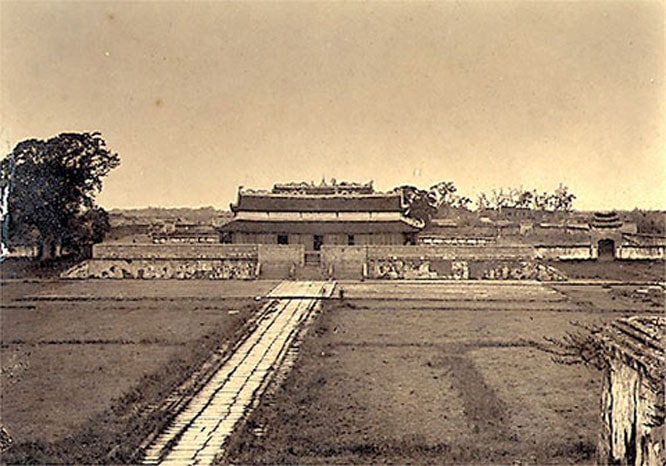
During the Ly Dynasty, Thang Long was planned on a broad scale, clearly defining the structure and dimensions of an imperial capital city. Within the inner citadel, the Hoang Thanh (Imperial Citadel) had four gates opening to the four cardinal directions, which functioned both as city gates and as major market gates. Surrounding Thang Long and extending into the areas outside the Hoang Thanh, residential quarters and villages were densely populated; nevertheless, large tracts of dense forests and marshlands, etc. still remained.

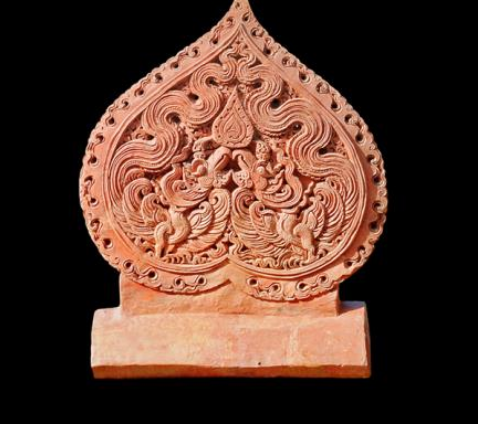
Phoenix-head statue and bodhi-leaf ornament decorated with a pair of phoenixes, discovered in pits A2 and A3 (Thang Long Imperial Citadel)
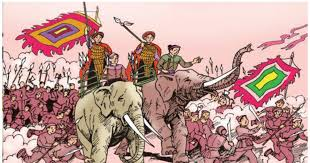
In 1054, Ly Thanh Tong ascended the throne and officially proclaimed the national name Dai Viet. One of the most important policies of the Ly dynasty was the organization and construction of the armed forces based on the principle of “ngu binh u nong” (soldiers residing among farming households). This policy ensured that agriculture retained its productive labor force while enabling rapid mobilization in times of war. In the eleventh century, the people of Thang Long, together with the entire country, successfully repelled the Song invaders, defending both the capital and the nation. Among the outstanding figures born in Thang Long was Ly Thuong Kiet. His original name was Ngo Tuan, and he came from Thai Hoa Ward, Tho Xuong District. From an early age, he demonstrated strong ambition, devoted himself to reading, studying military treatises, and practicing martial arts. Beginning his career as a palace guard official during the reign of Ly Thai Tong, his talent and moral integrity enabled him to rise to become a strategic military commander, eventually holding the position of Thai Pho under Ly Thanh Tong. In 1069, he was appointed as the vanguard general accompanying Ly Thanh Tong in the campaign against Champa, during which the Champa king Che Cu was captured. In recognition of his merits, the king adopted him as a foster son and granted him the royal surname Ly, thereafter known as Ly Thuong Kiet. Facing the expansionist designs of the Song dynasty, Ly Thuong Kiet implemented the strategy of “tien phat che nhan”—that it is better to strike first and blunt the enemy’s offensive than to remain passive and await attack. Subsequently, together with the people of Thang Long and the population across the country, he organized and constructed defensive lines to block the enemy along the northern routes and prefectures. At the same time, he personally traveled south to announce victories, redraw the maps of the three prefectures Bo Chinh, Dia Ly, and Ma Linh (corresponding to present-day Quang Binh and Quang Tri), recruit settlers, and strengthen frontier defenses. As a result, Champa and Chenla refrained from military action in response to the edicts of the Song court.
During the war against the Song invaders (1075–1077), Thang Long also produced many devoted sons and daughters who, regardless of noble origin, rushed to the battlefield when the nation was in peril, willingly undertaking any task to safeguard the country and its institutions. Among them were two royal princes, Hoang Chan and Chieu Van, who heroically sacrificed their lives while leading troops to block the enemy and prevent their advance into Thang Long. Another outstanding figure was Nguyen phi Y Lan (a senior royal consort), a talented woman who took charge of state affairs and the home front, ensuring stability while King Ly conducted military campaigns in the south. In times of peace, the people of Thang Long devoted themselves to production; in times of national crisis, they displayed courage and determination, ready to fight and sacrifice for the survival of the country.
The Ly dynasty established its capital in Thang Long from 1010 to 1226, spanning nine reigns, with the last ruler being Queen Ly Chieu Hoang.
The Tran dynasty was founded through the political strategy of Thai su (Grand Preceptor) Tran Thu Do, formalized by the marriage between Ly Chieu Hoang and Tran Canh. In 1226, Ly Chieu Hoang abdicated in favor of her husband, marking the beginning of Tran rule, which lasted from 1226 to 1400.
During the Tran period, the imperial capital of Thang Long was reorganized into two distinct zones: Cung Thanh Tu (the Palace of the Retired Emperor) and Cung Quan Trieu (the King’s Palace). In addition to Thang Long, Thien Truong was developed as a secondary capital, serving primarily as the residence and administrative center of the Thai Thuong Hoang (Retired Emperor).
(To be continued...)