
 Làng nghề
 Di tích văn hóa & lịch sử






♦ Dr. Le Thi Thu Huong
(continuation and conclusion)
Elegance in traffic participation and the use of transportation
Living in an urban environment, mobility and the use of transport, as well as traffic awareness, are important aspects that shape the character of Hanoians.
In the feudal period, within the imperial capital of Thang Long, kings and mandarins traveled by palanquin, while ordinary people mainly walked; some well-off families used hand-pulled carts, later replaced by cyclo rickshaws. At that time, traffic behavior required little discussion, because whenever a high-ranking official’s palanquin passed by, commoners were expected to move aside, both to give way and to show respect. When the French arrived in Hanoi and built tram lines running through the streets, traffic participation began to change. Although trams moved slowly, people still had to learn proper ways to board and alight. The line “Hanoi has trams going back and forth with their ringing bells” became a nostalgic memory of Hanoi in the early and mid-twentieth century.
Today, in the context of urbanization and international integration, traffic has become a pressing issue in major cities, including Hanoi as the capital. It is evident that current transport infrastructure development has not kept pace with economic growth and the increasing needs of the population. The key issue here is traffic awareness and behavior.
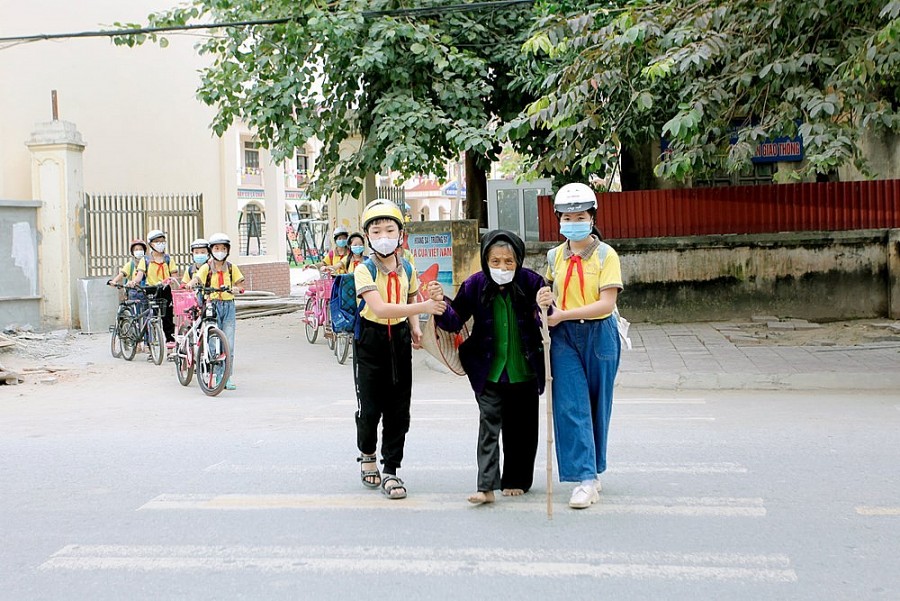
Helping elderly people cross the street - a beautiful aspect of traffic culture
Motorbikes remain the primary means of transport for Hanoians, with electric motorbikes and electric bicycles becoming more common in recent years, especially among students. These vehicles are compact, convenient for navigating narrow streets, and easier to park than cars. Due to crowded roads, motorbike speeds in Hanoi are generally modest, typically between 20 and 30 kilometers per hour. Most Hanoians comply with traffic laws and traffic lights. On buses, it is still common to see young people offering their seats to the elderly and women. At pedestrian crossings, images of young people and traffic police assisting elderly or visually impaired individuals are frequently observed. When accidents occur, many people readily stop to help. Such images reflect the elegance of Hanoians in traffic participation.
At the same time, the choice and use of transport among Hanoians have undergone significant changes. Hanoians are often considered more discerning in their choice of vehicles, valuing not only practicality but also design and brand. Some vehicles are extremely expensive, costing as much as building a hospital serving hundreds of people daily, yet offering no more utility than ordinary vehicles. They primarily satisfy personal preferences and, to some extent, serve as displays of wealth. This reflects a tendency toward extravagance or ostentatious consumption among a segment of Hanoians, running counter to the traditional values of moderation and simplicity associated with Hanoian elegance.
In traffic participation, there are still many problematic behaviors, such as speeding, reckless overtaking, running red lights, and not wearing helmets. Some young people even organize illegal street racing, leading to tragic accidents not only for participants but also for other road users. Many people lack traffic discipline, riding on sidewalks meant for pedestrians, ignoring designated lanes, especially during rush hours, when all vehicles try to weave and squeeze into any available space. Such poor traffic awareness directly causes conflicts and severe congestion in the capital. While infrastructure is being upgraded, public awareness and responsibility in traffic participation must also change. Sharing the road by strictly obeying traffic laws is essential. Punishment is only a short-term measure; what truly matters is educating the Hanoi community to build strong traffic awareness, so that positive behavior can influence visitors from other regions. Poor traffic discipline among local residents, combined with visitors who either do not fully understand traffic laws or imitate local behavior, risks further damaging the image of Hanoians in the eyes of outsiders, especially foreign visitors to Hanoi.
At present, Hanoi is renovating and upgrading its urban transport system in order to best serve the needs of Hanoians as well as people from other localities who come to the capital. Complying with traffic laws and showing courtesy and consideration while participating in traffic are the most important factors in promoting the elegant character of Hanoians. The use of environmentally friendly, economical, and compact means of transport is a trend that many Hanoi residents are moving toward. At the same time, strengthening and modernizing public transport, including the development of rapid and modern bus routes, is also among the key priorities currently being implemented by the capital. However, the elegance of Hanoians in traffic participation and in the use of transport does not need to wait until infrastructure is fully completed; rather, it requires a change in mindset and strict observance of traffic laws, which in itself contributes to enhancing the image of Hanoians as civilized and refined. Alongside the decline in traffic awareness is the widespread encroachment on sidewalks and roadways, turning public spaces of Hanoi’s once peaceful and ancient streets into private domains. This not only causes traffic congestion but also degrades urban aesthetics, while exposing various social problems and uncivilized, inhumane images right on the streets.
In summary, over thousands of years of history, from small riverside villages, residents of this land, together with people from all directions who migrated here, have formed the community of old and modern Hanoi. Living under conditions markedly different from other localities in the country - such as natural conditions, the role of an imperial capital and later a national capital through various historical periods, and relatively advanced socio-economic conditions - over time, the people of this region have developed distinctive character traits. These traits represent a convergence of regional personalities, along with the absorption of civilized values from the world through exchange, trade, and interaction, which were then selectively refined to suit life in the capital, the political center of the nation. Through the trials of history, these fine qualities have settled and crystallized in the personality of Hanoians and have “become the core realm of the enduring identity of the Vietnamese nation”[1]. Among these traits, elegance is the defining characteristic of Hanoians, widely recognized by people throughout the country and serving as a marker that distinguishes Hanoians from residents of other localities. This elegance is expressed across many areas of social life, most notably in communication and social conduct, cuisine, dress, and the appreciation of arts and culture, along with various other behaviors that reflect refinement in everyday life. As the capital continues to develop, the elegance of Thang Long - Hanoi, past and present, has inevitably undergone certain changes. A segment of the population, across different areas of social life, has displayed attitudes and behaviors that are unbecoming, undermining and contradicting the ethical values and fine character traits carefully nurtured and preserved by generations of Thang Long - Hanoi residents.
Overall, the character of Hanoians is marked by “self-respect, honesty, frankness, a strong sense of righteousness; a respect for intellect and morality over wealth and fame; politeness and refinement in conduct and communication; gentleness and flexibility. This elegance is an inherently Hanoian trait, which must be consciously preserved and promoted by the people as a precious asset of the capital”[2]./.
----------------------------------------------
[1] Vu Khieu, Bang Viet, Nguyen Vinh Phuc (2005), The Image of Hanoians in Modern and Contemporary Literature and Arts, ibid., p. 11.
[2] Ngo Thi Thanh Hang (2005), Scientific Conference Hanoians: Elegant and Civilized.