 Làng nghề
 Di tích văn hóa & lịch sử






♦ Prof. Ph.D. Nguyen Chi Ben
(next and end)
Alongside the cults of natural deities and sun worship, fertility beliefs also manifested in the form of craft-ancestor worship. In the somewhat blurred portrait of the heroic figure Saint Gióng, one can discern the shadow of a craft progenitor. The iron horse of the hero from Phù Đổng is said to breathe fire, scorching the village bamboo groves—traces of which are believed to survive today in the đằng ngà bamboo. This may be understood as a process of mythologization, through which the craft ancestor was rendered more radiant, distant, and sacred in the eyes of the worshipping community. Consequently, the original image of the hero was likely that of a cultural hero, a founding ancestor of a craft. In other words, the myth of the hero from Phù Đổng can be seen as a reflection of the achievements in bronze and iron metallurgy attained by ancient Vietnamese communities.
Thus, from the fragmented remnants of myth embedded in the religious–cultural sphere of Saint Gióng worship, one may discern layers of ancient belief systems that have continued to flow quietly—like an underground stream—down to the present day, though subsumed under a dominant current: the cult of the hero who defends the community against foreign invaders. The interaction and transformation of these cultural–religious layers gradually completed the portrait of the anti-invasion hero, as reflected in hagiographies, stele inscriptions, and related sources up to the end of the sixteenth century. Over the course of thousands of years, Saint Gióng has become a multifaceted symbol, embodying the virtues and deeds of a defender against foreign aggression, a protector of agriculture, a bringer of favorable rains and winds to rural villages, a deity who wards off floods, and an exemplary incarnation of loyalty and filial piety. He is a figure venerated and trusted continuously by both monarchical dynasties and popular belief. Numerous cultural and religious layers have accumulated like alluvial deposits, so that in a synchronic perspective there emerges the image of a heroic defender against foreign invasion—majestic, poetic, and beautiful. The enduring appeal and attraction of the figure of Saint Gióng and the Gióng Festival lie precisely in this dimension. The creativity of the Vietnamese inhabitants of the Kinh Bắc region in particular, and of the Red River Delta more broadly, may thus be regarded as a form of cultural creation of universal significance. The ritual performances of the Gióng Festival at Phù Đổng Temple are arranged according to the model of a battle. The ritual space of the festival is vast, and it is precisely this space that becomes the battlefield upon which the hero combats the enemy.

The Ritual Procession of Saint Gióng’s Horse
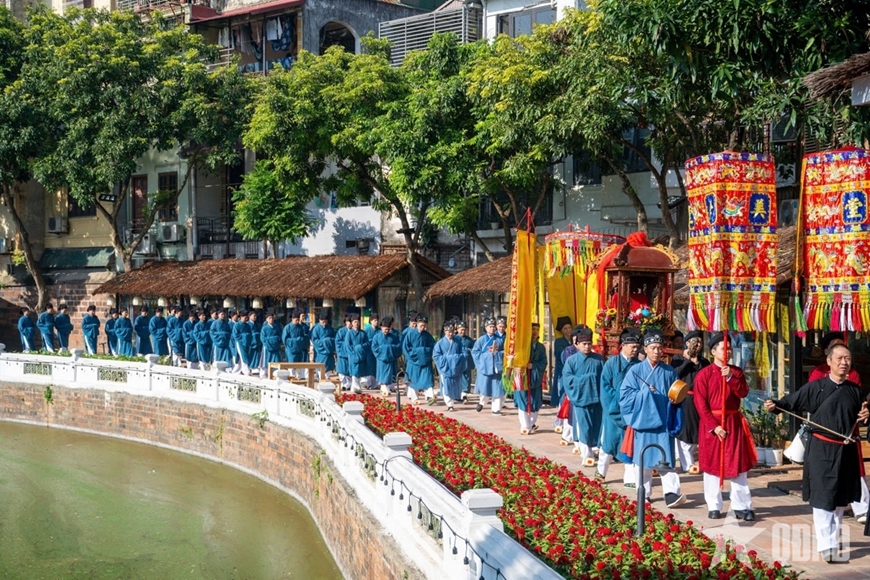
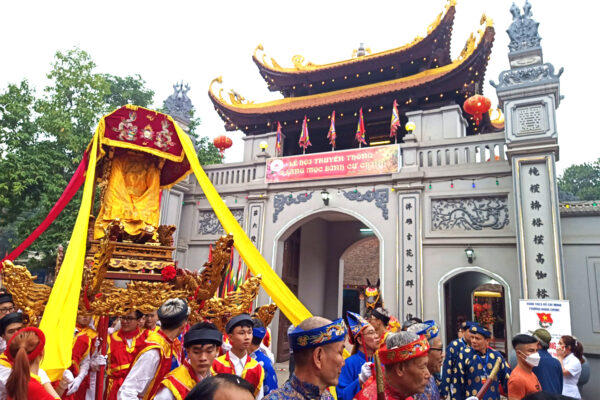
The value of the Gióng Festival at Phù Đổng Temple lies in the way popular tradition has sacralized and materialized one of the most magnificent heroic epics of the Vietnamese people through a system of symbolic ritual performances imbued with rich folk creativity and distinctive imagery. The performative repertoire of the Gióng Festival at Phù Đổng Temple represents a cultural creation of the Vietnamese people forged over thousands of years of history. In legend, the iron horse breathes fire; in ritual practice, it is transformed into a wooden horse painted red (or white), enshrined at Phù Đổng Temple and Sóc Temple, and ceremonially brought forth to “the battlefield” on the festival day. The roles of the flag master, drum master, gong master, minor drum master, the ritual performers of the Ải Lao singing guild, the royal attendants, the enemy generals, and others are all enacted by villagers themselves, each assuming a symbolic role. It is precisely this communal enactment that renders the Gióng Festival at Phù Đổng Temple a uniquely staged “ritual battle,” unparalleled within the corpus of Vietnam’s traditional festivals. At Sóc Temple, in addition to the ritual bathing of the statue of Saint Gióng, the festival also features the ceremonial procession of bamboo flowers offered to the Saint. These bamboo flowers are crafted from bamboo segments carved into blossom-like forms and dyed in multiple colors, most commonly yellow. The ritual of slaying the enemy general is symbolically enacted through flag-signaling performances, rather than literal representation.
Although the Gióng Festival is structured as a ritualized battle, the overarching message it conveys is fundamentally one of peace—a value the Vietnamese people seek to transmit across generations. Once the ritual battle concludes, the weapons are ceremonially returned to the temple, and both the army of Saint Gióng and the opposing generals symbolically partake together in the sacred offerings bestowed by Saint Gióng at Phù Đổng Temple, in an atmosphere of harmony and joy.
Therefore, the Gióng Festival at Phù Đổng Temple and Sóc Temple may be regarded as a living cultural museum, preserving multiple sedimented layers of cultural and belief systems. As observed by Professor PhD. Nguyen Van Huyen prior to the August Revolution of 1945: “This festival embodies an entire system of moral and philosophical thought, expressing harmony within the family and within the nation. It also aspires toward a vision of universal peace… It is truly a festival of peace and tranquility.”[1]. The aspiration for a peaceful nation, together with the longing for favorable weather and abundant harvests, constitutes the core message that Vietnamese communities have embedded in the Gióng Festival and conveyed to the wider human community. In recognition of these outstanding values, at its Fifth Session held from 15 to 19 November 2010 in Nairobi, the capital of the Republic of Kenya, the Intergovernmental Committee of UNESCO under the 2003 Convention officially inscribed the Gióng Festival at Phù Đổng Temple and Sóc Temple on the Representative List of the Intangible Cultural Heritage of Humanity. /.
----------------------------------------
[1] Phù Đổng Festival: A Legendary Battle in Vietnamese Tradition (1938), translated by Tran Dinh and Do Trong Quang, published in The Saint Gióng Festival, Culture and Information Publishing House, Hanoi, 2009, p. 178.