 Làng nghề
 Di tích văn hóa & lịch sử






♦ M.A. Nguyen Van Hoan
thuongWithin the system of ancient Buddhist relics in northern Vietnam, Thay Pagoda stands out as a place with a very distinctive character. Not only is it notable for its harmonious landscape of mountains and lakes, but the temple is also associated with the Zen Master Tu Đao Hanh, who had a profound influence on religious life and folk culture during the Lý dynasty. For those interested in traditional culture, Thay Pagoda is not merely a tourist attraction but a place where one can clearly sense the intersection of belief, history, and folk art.
Landscape space and geographical location
thuongThay Pagoda is located in Quoc Oai commune, Hanoi (former Ssi Sơn commune, Quoc Oai district, Hanoi), at the foot of Sai Son mountain (known as Thay mountain). This temple has a unique architecture that exemplifies the traditional Vietnamese spatial layout concept: a lake in the front and mountains at the back, creating a sense of balance and stability for the entire complex of relics.

thuongLong Tri Lake is situated directly in front of the pagoda, serving as a scenic buffer zone that creates an open and tranquil atmosphere. Viewed as a whole, the lake’s surface not only has aesthetic value but also helps highlight the pagoda’s architecture behind it. In the center of the lake lies the Water Pavilion, closely linked to water puppetry, a traditional folk cultural activity in the Red River Delta.
thuongBehind the pagoda lies Sai Son mountain, which preserves a system of caves and the path leading up to Thuong pagoda. This setting creates a sense of gradual separation from daily life, suited to the spirit of religious practice and contemplation.
Zen master Tu Đao Hanh and his historical legacy
thuongAccording to historical sources, Thay Pagoda was built in the Ly dynasty, associated with Zen master Tu Đao Hanh (1072-1116). He was a highly respected monk in his time, and also a figure who left a significant imprint on folk cultural life.
In the process of researching Thay Pagoda, the image of Zen master Tu Đao Hanh exists simultaneously on two dimensions: history and legend. From a historical perspective, he was an influential monk. From a folk perspective, he is venerated as a saint associated with many stories imbued with mythical elements. Clearly distinguishing between these two layers allows readers to approach the relic with a rational understanding while still appreciating the spiritual values that the legends convey.
The architectural complex of Thay Pagoda
thuongThe formal name of Thay Pagoda is Thien Phuc Tự, or ‘Pagoda of the Heavenly Blessing’. The complex comprises three main buildings: the Hạ pagoda, the Trung pagoda, and the Thuong pagoda, arranged along an axis from lower to higher ground, leaning against the slope of the mountain.
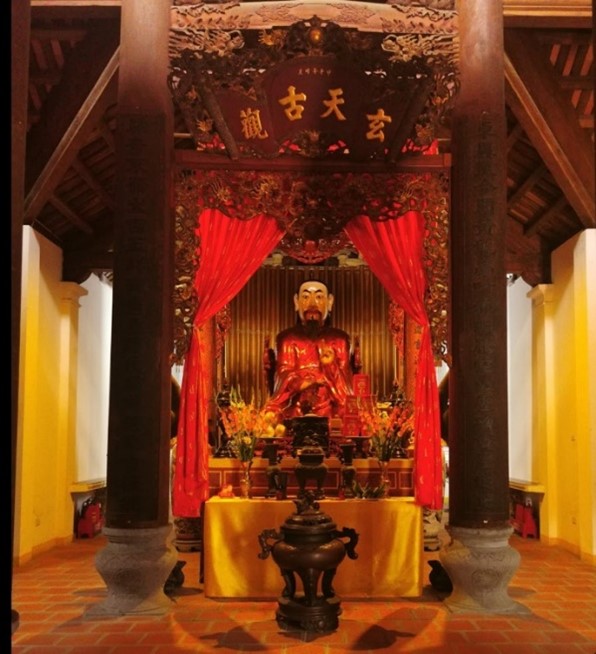
thuongThe Hạ (Lower) pagoda serves as the primary space for communal religious activities, featuring a traditional wooden structure, curved roofs, and a balanced layout. The Trung (Middle) pagoda worships Zen master Tu Đao Hanh, exuding a solemn, contemplative atmosphere. The Thuong (Upper) Pagoda is situated slightly elevated, associated with a legendary space for religious practice, creating a sacred point for the entire complex.

thuongIn addition to the main structures, the two ancient stone bridges, Nhat Tien Kieu and Nguyet Tien Kieu, spanning Long Tri Lake, are notable architectural details. Besides linking different parts of the temple, the bridges to the harmonious visual rhythm of the overall Thay Pagoda complex.
Folk water puppetry and folk cultural life
thuongOne of the features that makes Thay Pagoda special is its connection to water puppet art. According to folk tradition, Zen master Tu Đao Hanh made a great contribution in founding and passing on this art form to the local people.
thuongThuy Đinh, or the water pavilion in the middle of Long Tri Lake, is where water puppetry shows usually take place during festival occasions. These shows reflect the daily life, labor, and mindset of farmers in the past. When set within the Thay Pagoda complex, water puppetry is not only a form of performance but also a part of the community’s cultural life. It is preserved and passed down through many generations.
Thay Pagoda festival
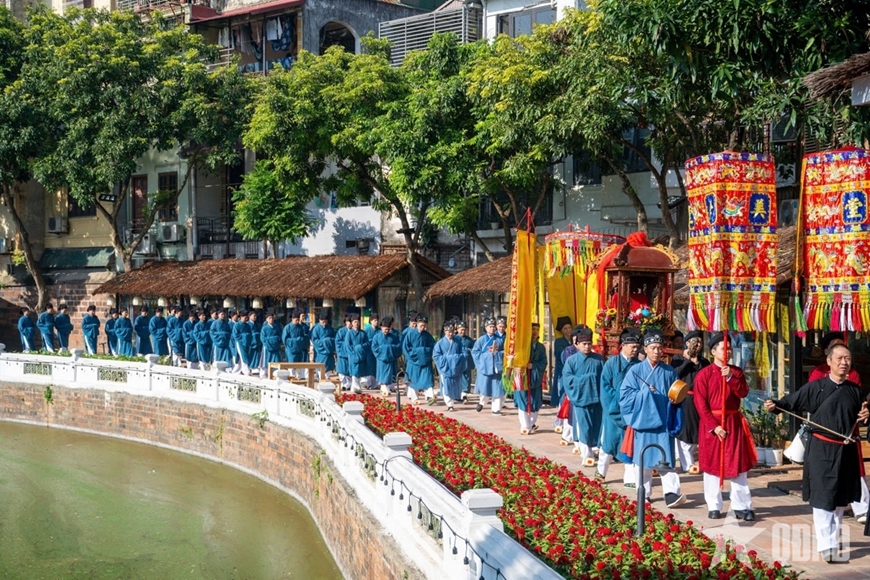
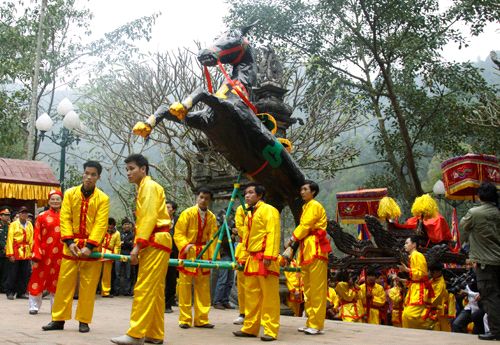
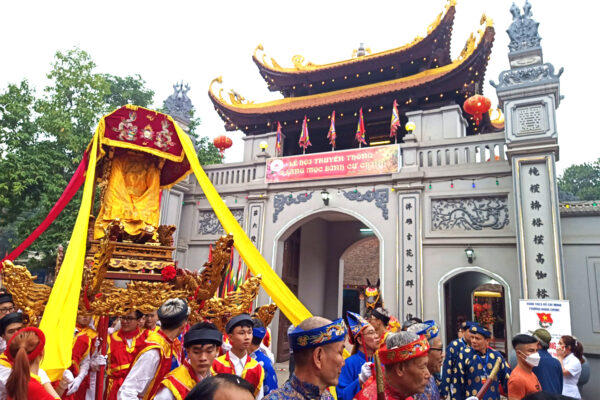
thuongThe Thay Pagoda festival is annually held in the third lunar month. This is one of the most typical traditional festivals of the old Đoai region. Alongside its role in commemorating the Zen master Tu Đao Hanh and the solemn Buddhist rituals, the festival also bears a strong sense of community cultural life, closely tied to the distinctive landscape of the Thay Pagoda complex.
thuongDuring the festival, visiting the pagoda is not limited to religious or spiritual practice but is also an occasion for local people and visitors to experience the entire mountain-pagoda-cave landscape around Sai Son mountain. From the Ha pagoda, Trung pagoda to the Thuong pagoda, and then along mountain paths to visit cave systems such as Cac Co cave, Thanh Hoa cave, Gio cave, etc, festival-goers immerse themselves in the early spring natural scenery, which is both tranquil and lively.
thuongThe blend of religious practices and scenic experiences is what makes the Thay Pagoda festival so unique. This is reflected in the well-known folk verse:
“Thay Pagoda Festival has Cac Co cave
Unmarried boys should not miss the chance to come here.”
thuongThe verse not only evokes the lively festival atmosphere but also illustrates that Thay Pagoda has long been a space for cultural interaction, where people come not only to worship but also to appreciate the beauty of nature, connect with the community, and enjoy the rhythm of traditional festival life. Thanks to this, the Thay Pagoda has maintained its enduring appeal, attracting large numbers of tourists every spring.
Cultural values and contemporary significance
thuongToday, Thay Pagoda is not only a religious site but also a familiar destination for those who love culture and history. Visiting the pagoda allows readers and visitors to directly observe the connection between architecture, landscape, and belief - elements that shape traditional Vietnamese cultural identity.
thuongFrom this perspective, Thay Pagoda can be regarded as a “living archive,” where cultural values do not exist in isolation but are blended with space and community life.
Conclusion
thuongThay Pagoda is a foremost relic that brings together many important values of traditional Vietnamese culture, from history, architecture, to religious practice and folk arts. With its distinctive geographical setting, harmonious landscape, and architectural complex bearing strong marks of the Lý dynasty, the pagoda not only reflects Buddhist life but also demonstrates the close relationship between people, nature, and the community.
thuongFor centuries, Thay Pagoda has served as a place for religious practice while also preserving and transmitting both tangible and intangible cultural values, especially water puppetry and traditional festivals. In the modern context, the accurate and scientific preservation, study, and presentation of Thay Pagoda are crucial for safeguarding national cultural identity and bringing cultural heritage closer to the public.
--------------------------------------------------
References
1. Ministry of Culture, Sports and Tourism.
Decision No 2408/QĐ-TTg dated December 31, 2014 on recognizing Thay Pagoda (Thiên Phúc Tự), Quoc Oai district, Hanoi, as a special national relic.
2. Ministry of Culture, Sports and Tourism.
Scientific dossier of the Thay Pagoda. Hanoi, 2013.
3. Nguyễn Vinh Phuc.
Hanoi – Places and History. Hanoi Publishing House, 2004.
4. Tran Quoc Vuong (Ed.).
Vietnamese culture – exploration and reflection. Culture of Vietnamese Ethnic Groups Publishing House, 2000.
5. Đang Thi Phong Lan.
The Art of Architecture and Sculpture at Thay Pagoda (PhD dissertation), Vietnam Academy of Social Sciences, 2012.
6. Nguyen Xuan Trung (Ed.), Tran Trung Hieu, Nguyen Thi Huong Mai, Luu Thi Dung.
Thay Pagoda, a special national relic. Dan Tri Publishing House, 2025.
7. Vietnam national authority of tourism.
Thay Pagoda - a typical cultural and spiritual destination of Hanoi. Hanoi, 2018.