
 Làng nghề
 Di tích văn hóa & lịch sử






♦ Dr. Le Thi Thu Huong
(continued and concluded)
Regarding Hanoi’s population, it comprises: indigenous residents - those who came to settle and make a living on this land since prehistoric times and who have remained attached to it over the centuries; and migrants from other places - a group that is highly complex and constantly changing in composition and size across historical periods, in connection with political upheavals and shifts in administrative boundaries.
In essence, the earliest inhabitants of ancient Hanoi were riverine agricultural communities. In addition, there were also traditional crafts such as bronze casting and pottery making. Thanks to favorable natural conditions, this land offered convenient opportunities for trade and commerce. Therefore, many indigenous residents, together with artisans from neighboring areas who came to Hanoi, gradually shifted toward traditional crafts associated with trade. From this process emerged urban quarters closely tied to craft production. During the Ly dynasty, 61 wards (phuong) appeared; by the Le dynasty, in 1466, Thang Long was reorganized into 36 wards, defined both by administrative boundaries and by distinctive craft specializations. Residents clustered according to craft wards, engaging in handicrafts while also trading. This segment may be regarded as the core resident community of Thang Long - Hanoi. Today, long - established Hanoians mainly live in the inner - city districts, with the central nucleus being Hoan Kiem, Ba Dinh, part of Tay Ho, Hai Ba Trung, and Dong Da (now forming part of the central area).
Under the feudal era, the population of Thang Long - Hanoi included the royal family, mandarins, soldiers, monks, and commoners such as artisans, merchants, and farmers. There were also a small number of people whose roots dated back to the former Protectorate headquarters. A portion of the Chinese community arrived in Thang Long relatively early, engaging in commerce and forming an entire street - Phuc Kien Street (now Lan Ong Street) - primarily specializing in traditional Chinese medicine. Phuc Kien Street was one of the 36 ancient streets and wards of old Hanoi. Over time, the Chinese who came to Hanoi to live and work became Vietnamized and “Hanoianized,” becoming a small part of the city’s resident community. Under diverse circumstances, people from many localities converged on Thang Long - Hanoi: some came to study or serve in government (scholars and officials); others came to make a living (artisans, traders, and so forth). There were also “war captives” from clashes among feudal factions who were brought to Thang Long - Hanoi - among them outstanding individuals, intellectuals, artisans, and artists, who were transferred to the capital. Historical records note that after campaigns to suppress Champa uprisings, from the Ly period in the 11th century, many “captives” were taken to Thang Long. A visible legacy of the Cham people’s contribution to the development of the Thang Long capital can be seen in Cham bricks used in constructing architectural works in Thang Long. Among the most notable are the Bao Thien Tower, stone - rimmed wells reflecting Cham technical style, and especially the artifacts unearthed at the Hoang thanh Thang Long (Thang Long Imperial Citadel).
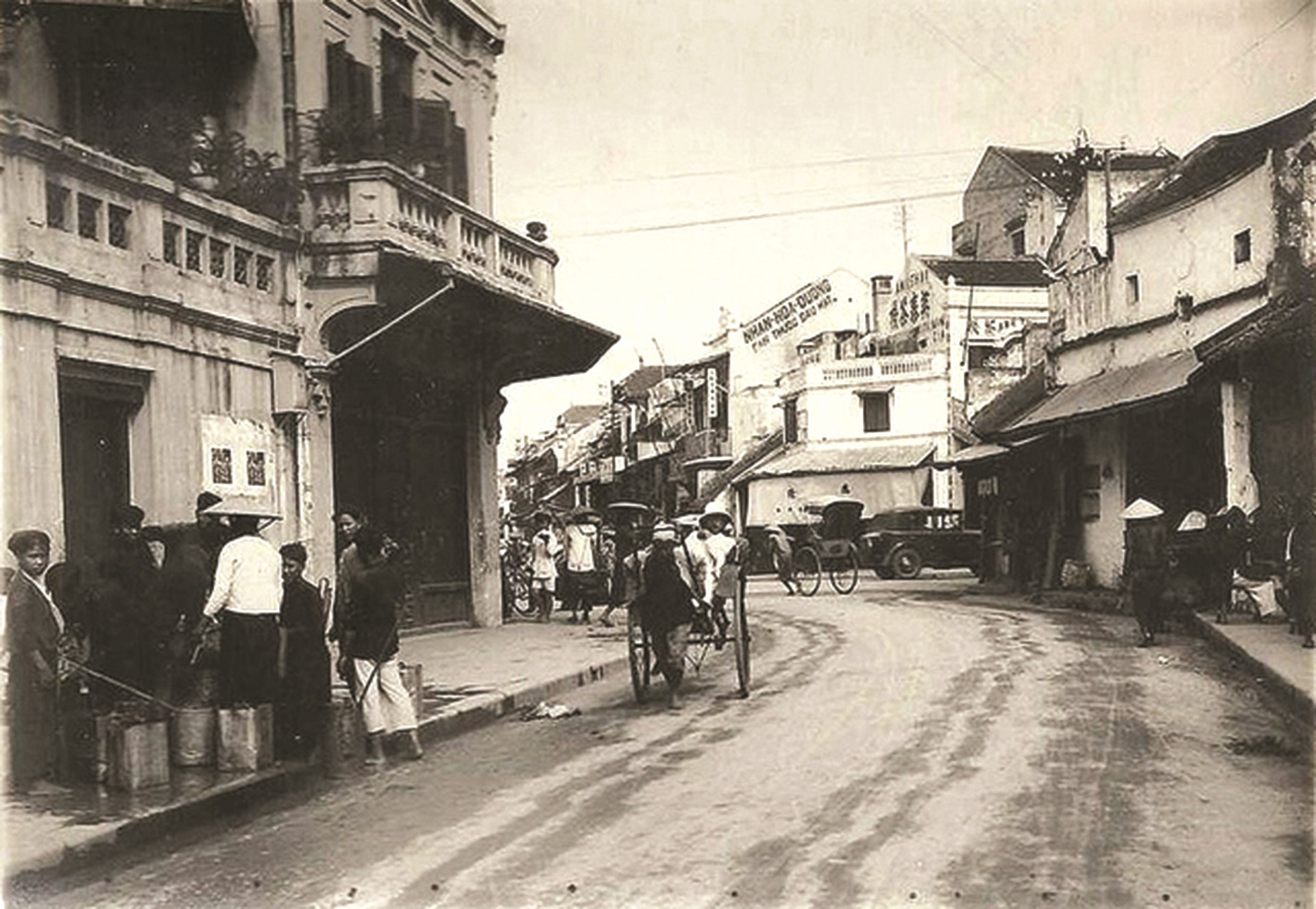
Lan Ong Street is well known for its distinctive architecture, bearing characteristic imprints of traditional East Asian medicine culture
Conflicts among feudal dynasties - such as the Nam - Bac Trieu period and the Trinh - Nguyen division - also brought about, to some extent, changes in the population and resident community of Thang Long - Hanoi. The most significant changes occurred among groups that were not indigenous to Hanoi. During the Le Trung Hung period, soldiers from Thanh - Nghe An were present in considerable numbers in the Thang Long capital, contributing to the problem of “kieu binh” (arrogant, unruly troops). People from Thanh - Nghe An - primarily soldiers’ families - also increasingly moved to Thang Long to settle and seek livelihoods. From the 17th century, Thang Long likewise saw the presence of Western merchants coming to trade, such as the Dutch and the Portuguese. Thang Long became a bustling trading center of a notably diverse community. The prosperity encapsulated in the saying “Thu nhat Kinh Ky” was created precisely by the Thang Long resident community, comprising both indigenous inhabitants and migrants who came to Thang Long - Hanoi.
In the modern period, when Hanoi became a French concession (1888), the French came to Hanoi in large numbers. One segment consisted of colonial officials who held key posts in civil and military agencies within the Indochina ruling apparatus that France established in Hanoi, such as the Office of the Governor - General, the Office of the Resident - Superior, the Hanoi municipality, the French military command, the Federal Security Service, and the High Court, among others. A large proportion of senior colonial officials were associated with powerful French monopoly-capital groups, and some held shares or investments in those conglomerates. A second segment comprised business owners (groups, companies, firms, etc.) operating production and commercial establishments or branches, with offices based in Hanoi. French capital occupied the most important positions in Hanoi’s economy, holding monopolies in many sectors and wielding considerable influence. The French also constituted a large proportion of the City Council and had a decisive voice within it. Because the French population in Hanoi was relatively large, there were schools reserved for French children, such as Albert Sarraut Secondary School (established in 1919), regarded as the most renowned in Indochina. There were also other schools such as the Petit Lycee (primary level), a French girls’ school, and later the private Lyceum Victor Hugo (1951 - 1954). These schools taught entirely in French, following curricula from metropolitan France.
Hanoi also had foreign bourgeois communities such as the Chinese, Indian, and Japanese, though the Chinese were by far the largest. Chinese bourgeois merchants had long engaged in business in Hanoi, mainly within the Old Quarter areas such as Phuc Kien, Hang Buom, Hang Ngang, and Hang Bo. Their activities focused primarily on trade and services. They operated many major shops in Hanoi, such as Chi Long, Chi Hung, Chinh Thai, Ninh Thai, and Nhi Thien Duong.
The Indian bourgeois group was small in number, mainly trading textiles and silk on Hang Dao and Trang Tien streets. In the course of business, Chinese merchants competed with Vietnamese entrepreneurs and were also squeezed by French capital. To some extent, therefore, they too developed anti-French and anti-Japanese-fascist sentiments. Many among them sympathized with the Viet Minh. Children of Chinese bourgeois families studied at schools for Chinese students, and Chinese students also participated in activities alongside Vietnamese students in struggles against Japanese fascism in Hanoi during 1940 - 1945.
Japanese bourgeois activity was not significant; only when the Japanese army entered Hanoi did Japanese companies truly establish a presence in the city, such as Mitsui, Mitsubishi, and Dai Nam Kosi.
Thus, from a very early period, the land of Thang Long - Hanoi witnessed the settlement of ancient Vietnamese communities. Owing to its favorable geopolitical position, the process of population concentration and the formation of Hanoi’s resident community also took place early, with two main components: indigenous Hanoians and migrants from other places who, under different circumstances, came to Hanoi. The land of Hanoi naturally filtered and shaped a highly distinctive Hanoian character.
----------------------------------------------------
References
1. Do Thi Minh Duc - Nguyen Viet Thinh (2019), Population of Thang Long - Hanoi, Hanoi Publishing House.
2. Phan Huy Le (editor) (2012), History of Thang Long - Hanoi, Volume 2, Hanoi Publishing House.
3. Nguyen Quang Ngoc, Le Thi Thu Huong (co-editor), (2018), Textbook on Hanoi Studies, Vietnam National University, Hanoi Publishing House.