 Làng nghề
 Di tích văn hóa & lịch sử






♦ Prof. Ph.D. Nguyen Chi Ben
The cultural space of the Gióng Festival originated in the northern region, historically known as Bắc Bộ or Kinh Bắc. Despite changes in geographical boundaries over the course of history, the area in which the Gióng Festival is practiced remains predominantly situated on the northern bank of the Red River. The principal creators, bearers, and organizers of the Gióng Festival at Phù Đổng Temple and Sóc Temple in particular, and in other villages more broadly, are Vietnamese peasants whose livelihoods are rooted in wet - rice cultivation. If the cultural constants of the Red River Delta are understood to consist of the peasantry, wet-rice agriculture, and the village community, these constants have, to the present day, remained largely intact. It is precisely these enduring cultural foundations that account for the remarkable longevity and vitality of the festival dedicated to the heroic figure of Phù Đổng Village throughout history.
Saint Gióng is a legendary figure who has been sacralized and historicized by the people, thereby becoming a subject of popular belief. The myth of Saint Gióng did not assume a fixed form from the outset, but rather underwent continuous transformation over time. The narrative motif of a hero who repels foreign invaders, protects the community and the nation, who is born under extraordinary circumstances and rapidly grows into a warrior - hero, is widely attested in the mythological traditions of peoples around the world. From a synchronic perspective, the myth of the heroic figure of Gióng Village may be divided into three principal phases, each characterized by the following motifs:
a. The Phase of Birth and Formation
- The mother steps upon a miraculous footprint.
- She conceives for more than three years, and the child is born unable to speak or smile for three years thereafter.
- The child undergoes sudden and extraordinary growth (stretching himself to an immense stature), sustained by the collective nourishment of relatives and the village community with simple foods such as rice and eggplants.
- By royal command, the court and the local community jointly provide the hero with iron weaponry - an iron suit of armor, an iron horse, and an iron rod—enabling him to go to battle against the invaders.
b. The Phase of Combat
- The hero marches into battle alongside other military commanders.
- When the iron rod breaks in combat, he uproots bamboo to use as a weapon against the enemy.
- He engages in battle with aquatic monsters.
c. The Phase of Apotheosis (Transformation)
- The hero ascends to the heavens, relinquishing all worldly honors and material rewards.
- He continues to bestow protection upon later dynasties in their struggles against foreign invaders.
Thus, it may be observed that the myth of Saint Gióng belongs to the narrative type of the heroic figure who repels foreign invaders on behalf of the community, one who is born to assume the mission of defending the Red River Delta population against external aggression. The narrative sequence - extraordinary birth → response to the call to combat → communal provision of weapons → engagement in battle → victory → return—constitutes a familiar heroic pattern in stories of resistance against foreign invasion, bringing peace to the community and the nation. This narrative type is not unique to the Vietnamese tradition, but represents a motif of universal, trans-cultural significance. The distinctiveness of the Saint Gióng myth, however, lies in the motif of ascension to the heavens following the completion of his martial mission. This element stands as one of the most aesthetically evocative and romantic motifs within Vietnamese narratives of the anti-invasion hero, and is rarely encountered in comparable heroic traditions among other ethnic groups in Vietnam, and only sporadically in the broader corpus of world heroic mythology.

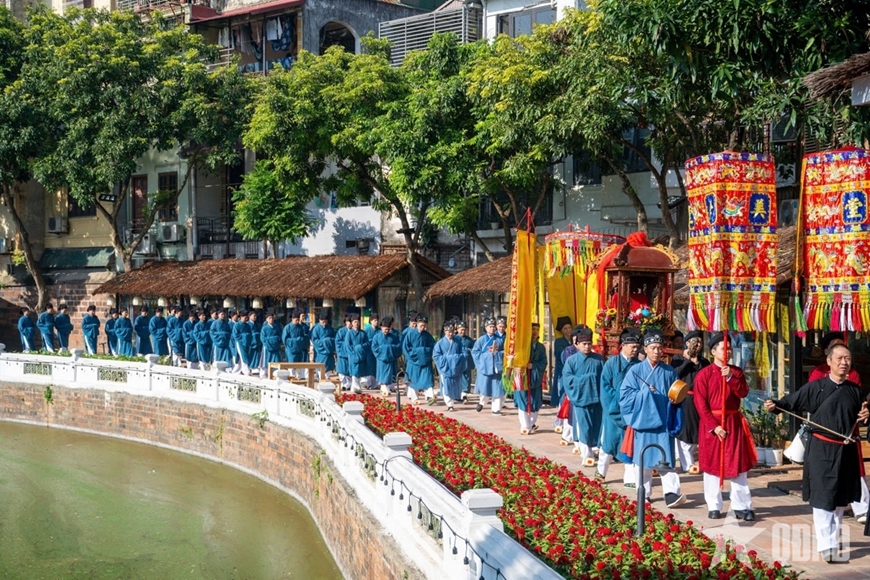
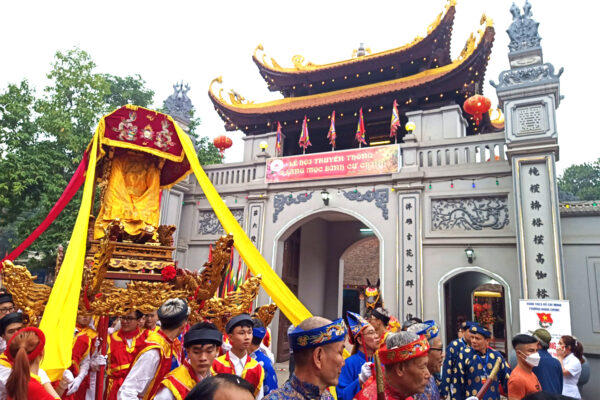
At the Gióng Festival held at Sóc Temple, a procession of eight ritual offerings is performed, followed by sacrificial rites conducted by the constituent village communities.
The foremost value of the Gióng Festival lies in the presence of multiple layers of cultural and religious beliefs that have been sedimented within its myths and ritual practices. Foremost among these is the belief in the worship of natural phenomena. The image of a natural deity preserved in folk tradition as a mythological archetype evokes associations with narratives of miraculous beings closely connected to the primordial stage of human history. Regrettably, for a variety of historical and cultural reasons, Vietnamese mythology became fragmented through prolonged contact with cultures from the north. Rather than developing into a coherent mythological system, it survives largely in the form of fragments and residual mythic motifs. Folk rhymes from the Nghệ region once recounted tales of these extraordinary figures:
"Ông tát bể
Ông kể sao
Ông đào cây
Ông xây rú"
Therefore, the ancient cultural–religious stratum of early Vietnamese belief embedded in the myth of Saint Gióng may be understood as a vestige of the figure known as Ông Đổng. Folk tradition mythologized a natural phenomenon into a system of belief, embodied in a deity - like figure for worship. It is not coincidental that, in the Phù Đổng area in earlier times, there existed an ancient shrine dedicated to Ông Đổng, where offerings consisted of a bowl of rice and a plate of eggplants - vegetarian offerings presented during the season of thunderstorms (the ninth day of the fourth lunar month). During the eggplant harvest season, villagers would set aside an entire sào of eggplants specifically for Ông Đổng to “harvest,” while in adjacent fields they placed long bamboo poles, with one end frayed like cotton, as markers reserved for Ông Đổng, so that he would not damage the remaining crops. Ông Đổng was thus regarded as a deity of thunder and rainstorms, which explains his appearance in nights of wind and rain. It is this very mythological conception that determined the observance of the Gióng Festival at Phù Đổng on the ninth day of the fourth lunar month. Professor Tran Quoc Vuong aptly characterized the Gióng Festival as a “festival of thunderstorms"[1]. This designation is well founded, for the period marks the closing phase of the spring festival season; early in the fourth lunar month also signals the onset of the rainy season in the Red River Delta, when:
"Tháng tư cày vỡ ruộng ra
Tháng năm gieo mạ chan hòa nơi nơi."
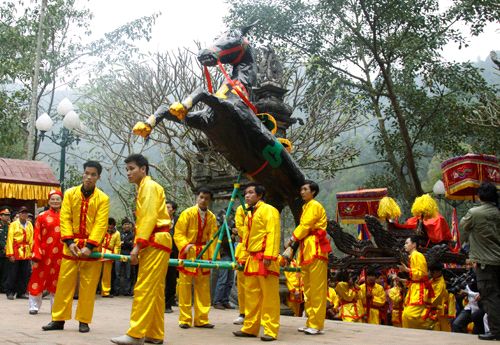
The Gióng Festival marks the commencement of a new cycle in the life of the rice plant and the beginning of a new agricultural season. Alongside the belief in thunder and rain deities, the Gióng Festival also encompasses cults associated with trees and stones. All elements connected with the foreign invaders defeated by Saint Gióng are symbolically linked to stone. The stone horse, as well as the stake used to tether the invaders’ horse in the Châu Cầu area, is represented by a stone pillar. Such elements collectively evoke an ancient belief system of early Vietnamese communities. At the summit of Sóc Mount, according to local elders, there once stood a highly sacred ancient shrine, within which lay a large stone bearing what was believed to be the deeply imprinted footprint of Ông Đùng. This, too, reflects a form of belief associated with the veneration of natural phenomena. Another important dimension of the Gióng Festival’s religious layer is the cult of sun worship. Both Phù Đổng Temple and Sóc Temple house a white wooden horse within their main sanctuaries, which serves as a symbol of solar worship. In mythological thinking, the horse - or the chariot - is frequently employed as a representation of the sun. For communities whose primary mode of subsistence is wet - rice cultivation, sun worship holds particular significance. Accordingly, the myth of Saint Gióng and the sacred animals preserved within the associated sites may be understood as enduring reminders of the solar cult characteristic of Đông Sơn culture, once prevalent among Vietnamese communities in this region. As Professor Tran Quoc Vuong observed: “One remaining Đông Sơn vestige preserved within the Gióng Festival is the cult of sun worship. The Đông Sơn sun, which once appeared as a stellar symbol at the center of bronze drums accompanied by scenes of birds flying counterclockwise, was later transformed into the image of the white horse at Gióng Temple and the iron horse in the Gióng legend”[2]. It is also noteworthy that the costumes of the “enemy generals,” as recorded in Bắc Ninh tỉnh khảo dị, state: “Any woman chosen to play the role of a general wears red garments and a military cap”[3] . Similarly, the individual portraying the Heavenly King is likewise clad in red attire. These elements represent residual reflections of solar worship symbolism. The most explicit manifestation of this solar cult is found in the flag-command chess performance conducted by Ông Hiệu Cờ (the ritual figure representing Saint Gióng). The performance consists of three rounds played in a forward direction and three in reverse, enacted at Đống Đàm and Soi Bia. The color of the flag itself symbolizes the sun. This flag-command chess ritual metaphorically depicts the sun’s movement over the course of a day: from east to west during daylight hours, and from west to east at night. Furthermore, the ritual reenactment of Saint Gióng’s departure for battle during the festival is conducted precisely at noon. According to the myth, Saint Gióng’s journey - from the battlefield in the east (Mount Châu Sơn) to the west (Sóc Mount), culminating in his ascension to the heavens - symbolically mirrors the sun’s daily trajectory from east to west.
(To be continued…)